


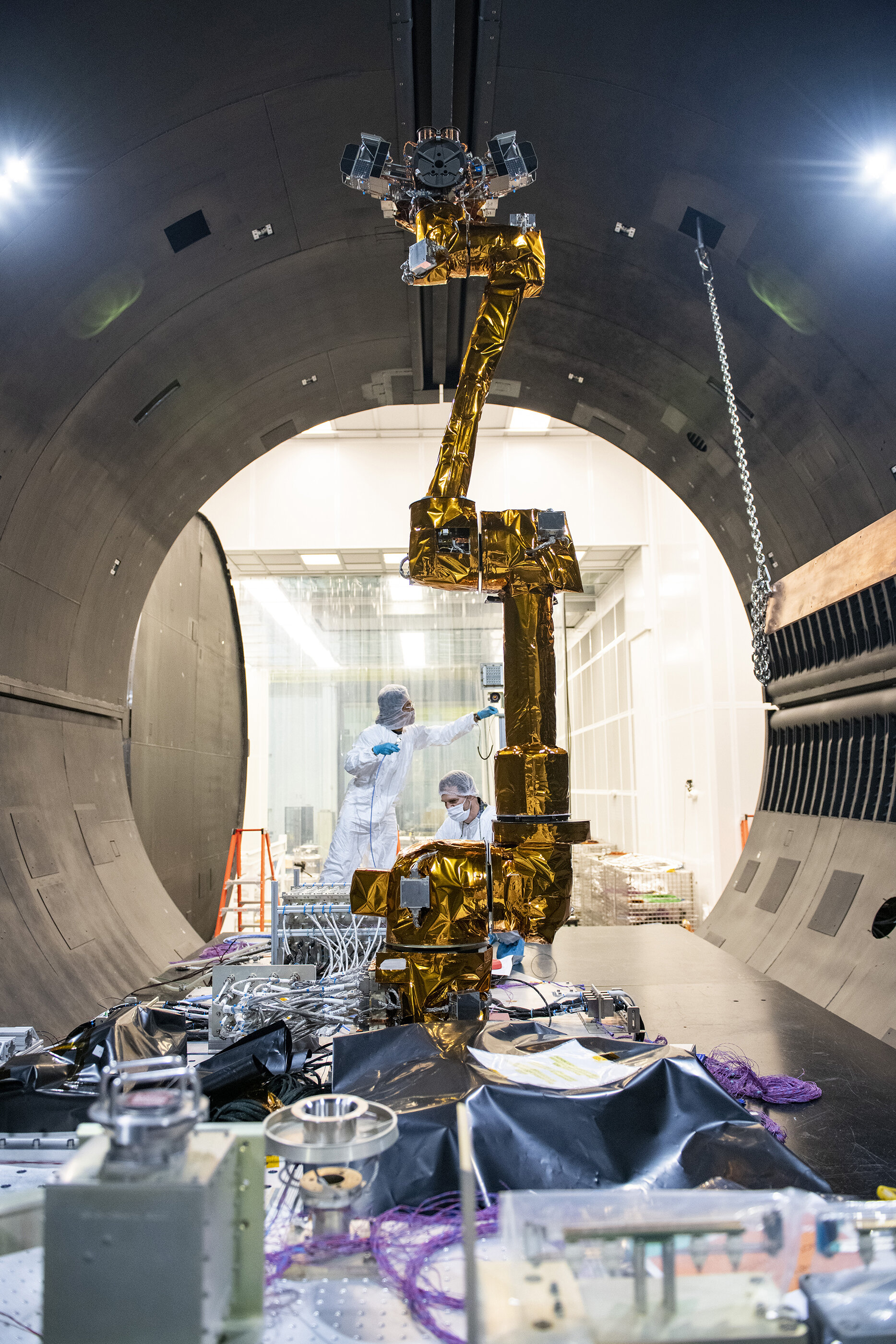
Engineers on the U.S. Naval Analysis Laboratory’s (NRL) Naval Heart for House Expertise (NCST) not too long ago accomplished robotic payload element degree testing for the Protection Superior Analysis Tasks Company (DARPA) Robotic Servicing of Geosynchronous Satellites (RSGS) program.
As soon as on-orbit, the RSGS robotic servicing automobile will examine and repair satellites in Geosynchronous Earth Orbit (GEO), the place a whole bunch of satellites present communications, climate monitoring, assist nationwide safety missions, and different important capabilities.
The RSGS program is a public-private partnership between DARPA and Northrop Grumman’s SpaceLogistics subsidiary, with NRL growing the robotic servicing payload.
“This partnership will allow revolutionary servicing capabilities to business and authorities customers for visible diagnostics, upgrades, orbit adjustment, and satellite repairs,” Bernie Kelm, Superintendent of the Spacecraft Engineering Division, NCST, stated. “Because the robotic payload developer, we designed this modern set of spaceflight {hardware} and software program that may advance nationwide capabilities in satellite servicing.”
The RSGS payload consists of flight {hardware} elements, robotic management algorithms, a number of extremely personalized electronics designs, and flight software program operating on 5 single-board computer systems. NRL additionally specified and procured two dexterous seven-degree-of-freedom robotic arms, outfitting them with control electronics, cameras, lights, and a robotic instrument changer.
Moreover, NRL developed the robotic instrument to grapple buyer satellites through their normal launch automobile interface and procured one other instrument to seize resupply components which can be appropriate with DARPA’s Payload Orbital Supply (POD) design normal.
“Our numerous group of NCST engineers has targeted their efforts on the robotic payload for the RSGS Program for the final seven years,” William Vincent, NRL’s RSGS program supervisor, stated. “The Robotic Payload is certainly one of NRL’s most intricate payload developments ever.”
NRL engineers developed a number of energy and management avionics operating on a distributed SpaceWire community to assist an prolonged period mission to regulate all of the sensors and actuators in a strong and redundant method. NRL procured panchromatic and colour cameras, alongside designing LED lighting models to offer situational consciousness throughout robotic actions.
“Our algorithms group developed machine imaginative and prescient, place management, collision avoidance, and compliance management algorithms that assist robotics management and allow autonomous grapple capabilities,” Vincent stated. “The algorithms are carried out in flight software program which additionally gives all the command-and-control performance for the payload and gives management interfaces to the spacecraft bus.”
Robotic motions require particular planning to make sure secure spacecraft operations. NRL has developed the Built-in Robotic Workstation (IRW) to perform simply that. The IRW helps mission planning for the event of recent mission actions. As soon as a mission is deliberate, the IRW helps screening actions to prescreen all robotic movement instructions in a payload simulator to confirm command hundreds earlier than they’re despatched.
Lastly, utilizing NRL’s Neptune floor management software program, the IRW instructions all robotic payload actions and shows and traits payload telemetry throughout operations. To execute this effort, a talented techniques engineering group spent years performing system analyses, documenting necessities and interfaces, and producing a strong verification and validation plan.
“The engineers labored intently with the mixing and take a look at groups to make sure the system meets all necessities because it comes collectively for element, subsystem, and payload degree testing,” Vincent stated. “As soon as full, the robotic payload will allow the wide selection of missions envisioned and future missions not but imagined.”
The RSGS group not too long ago accomplished environmental testing of the primary of two flight robotic arm techniques. This included simulating the launch setting in NRL’s vibration lab, simulating each the vacuum and excessive temperature ranges of space in NRL’s thermal vacuum (TVAC) Chamber, and making certain electromagnetic interference (EMI) performance in EMI chamber testing.
Throughout TVAC testing, the robotic arm system demonstrated efficiency over temperatures representing precise on-orbit situations. Underneath the cruel temperature and vacuum situations of space, the robotic arm carried out quite a lot of operations together with operating pre-planned robotic calibration actions, instrument actuation, and digital camera and light-weight capabilities.
The second robotic arm system is built-in with a separate testbed that has the complete flight avionics suite. It’s at the moment going by movement efficiency testing.
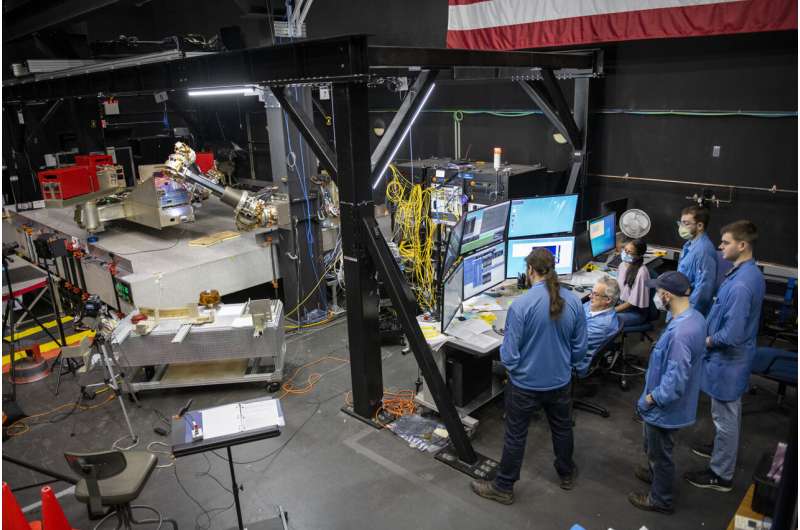
This fall, the second arm system will full environmental testing. Robotic efficiency testing to exhibit and confirm robotic algorithms’ operate is underway within the Robotics Testbed (RTB) at NRL’s House Robotics Laboratory. The RTB consists of a non-spaceflight model of the flight robotic arm system and avionics {hardware} operating flight software program. This high-fidelity robotics testbed permits floor verification of many system-level robotic efficiency traits for the RSGS payload.
Compliance Management algorithm characterization and Marman Ring Detector algorithm efficiency characterization have been accomplished. Contact dynamics testing within the RTB is underway, which makes use of a sled floating on a skinny layer of air to simulate the arm contacting consumer space automobiles ranging in mass from 75—3,000kg (165—6,613lbs.). Grapple, articulation, and launch testing is scheduled later this summer season.
The flight software program group is getting ready to start out qualification testing. Testing takes place in a software program testbed with a real-time dynamic simulation that generates simulated robotic arm pose inputs for the robotic management algorithms and dynamic imagery for enter into machine imaginative and prescient algorithms. This testbed permits the NRL group to check the flight algorithms with sensible management loops to totally confirm the system totally earlier than launch.
“The techniques engineering and verification efforts required by RSGS are intensive,” Amy Hurley, NRL’s Lead Techniques Engineer, stated. “It’s wonderful to see years of techniques engineering and a powerful verification and validation plan come collectively efficiently.”
Offered by
Naval Research Laboratory
Quotation:
Engineers prepared modern robotic servicing of geosynchronous satellites payload for launch (2022, November 9)
retrieved 9 November 2022
from https://phys.org/information/2022-11-ready-robotic-geosynchronous-satellites-payload.html
This doc is topic to copyright. Other than any honest dealing for the aim of personal examine or analysis, no
half could also be reproduced with out the written permission. The content material is supplied for info functions solely.