


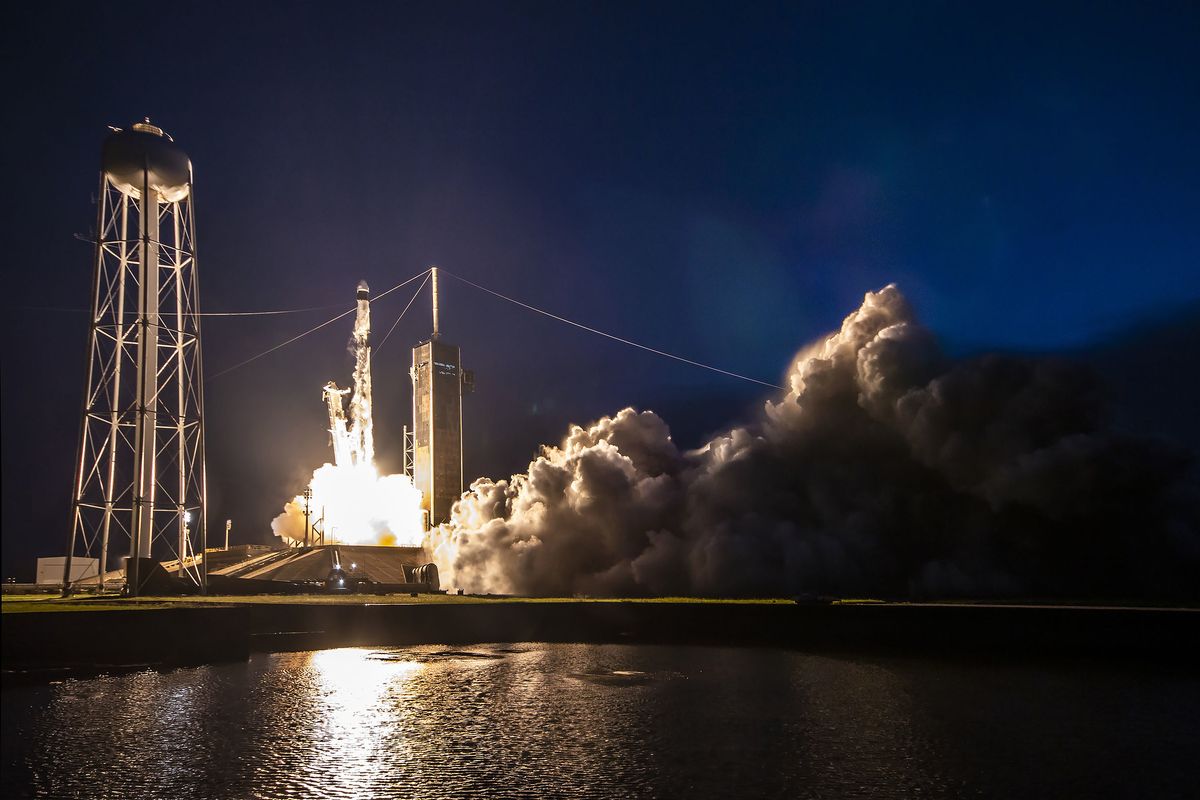
Tropical Storm Nicole has pushed the liftoff of SpaceX’s subsequent cargo mission to the Worldwide House Station (ISS) again by three days.
The robotic flight, referred to as CRS-26, had been scheduled to raise off from Pad 39A at NASA’s Kennedy House Middle (KSC) in Florida on Nov. 18. However Nicole, which slammed into Florida’s Space Coast as a Class 1 hurricane on Thursday (Nov. 10), modified that plan.
“NASA and SpaceX now are concentrating on no sooner than Monday, Nov. 21, pending vary approval, for launch of the corporate’s twenty sixth industrial resupply providers mission to the International Space Station for the company,” NASA officers wrote in a brief update on Thursday (opens in new tab).
“Mission groups will proceed to watch any extra potential impacts because the storm progresses,” they added.
Associated: 8 ways that SpaceX has transformed spaceflight
CRS-26 will ship SpaceX’s Dragon cargo capsule aloft atop a Falcon 9 rocket. The freighter is filled with provides, scientific experiments and {hardware}, together with a set of superior solar arrays that can increase the orbiting lab’s energy output.
One other high-profile mission is scheduled to raise off from KSC within the coming days as properly — NASA’s Artemis 1, which is sitting atop the middle’s Pad 39B.
Artemis 1 will use NASA’s new Space Launch System (SLS) megarocket to launch an uncrewed Orion capsule to lunar orbit. The company is at present concentrating on Nov. 16 for the extremely anticipated liftoff, although that would change; mission group members nonetheless want to completely assess how the Artemis 1 stack weathered the storm.
We’ll study extra about that quickly; NASA is holding a press convention right this moment (Nov. 11) at 3 p.m. EST (1800 GMT) to debate its newest Artemis 1 plans. You may take heed to it stay right here at House.com.
Dragon is one in all three robotic spacecraft that at present fly cargo to the ISS. The opposite two, Russia’s Progress car and Northop Grumman’s Cygnus, are expendable, burning up in Earth’s environment when their missions wrap up. Dragon, in contrast, is reusable, coming all the way down to Earth safely for parachute-aided ocean splashdowns.
Two Progress automobiles and one Cygnus are docked on the ISS in the mean time. The Cygnus arrived on Wednesday (Nov. 9), making the orbital rendezvous regardless of deploying solely one in all its two solar arrays. A Dragon can also be hooked up to the orbiting lab, however that one’s a crew car; the capsule is flying SpaceX’s Crew-5 mission for NASA, which carried 4 astronauts to the ISS final month.
Mike Wall is the writer of “Out There (opens in new tab)” (Grand Central Publishing, 2018; illustrated by Karl Tate), a guide in regards to the seek for alien life. Observe him on Twitter @michaeldwall (opens in new tab). Observe us on Twitter @Spacedotcom (opens in new tab) or on Facebook (opens in new tab).