


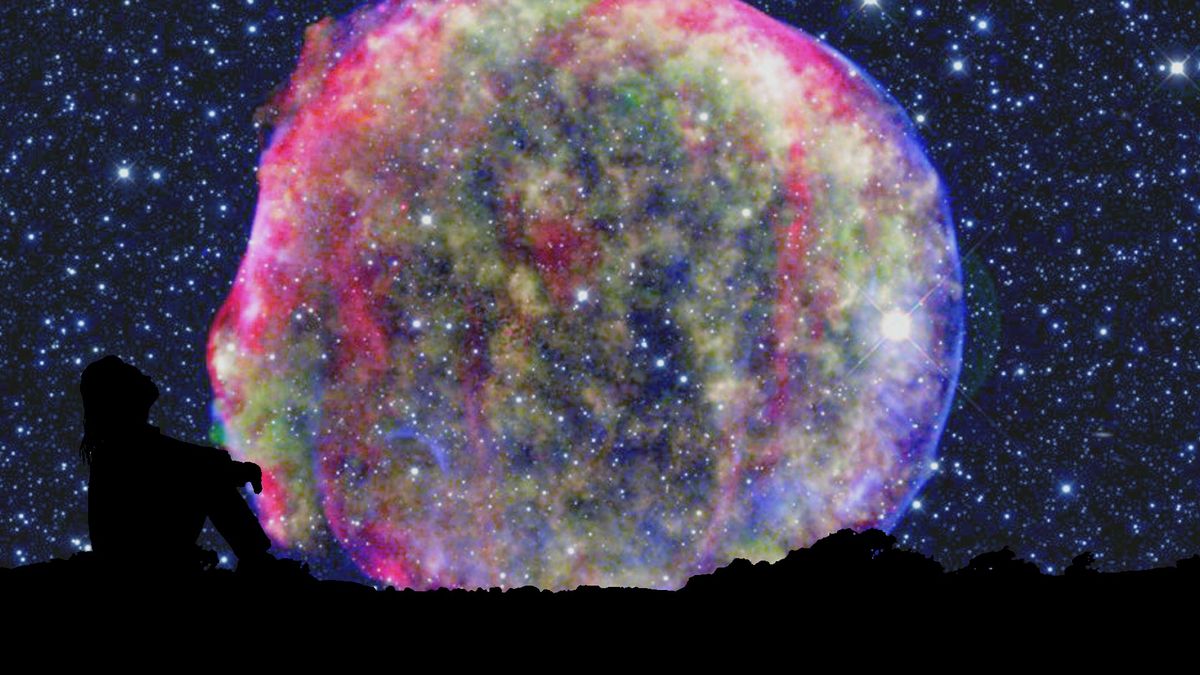
One of the vital spectacular celestial sights ever seen all of a sudden appeared within the northern evening sky 450 years in the past this month: a “new” star within the constellation Cassiopeia (the Queen). It was probably the most good nova recorded in some 500 years and, to this day, stays certainly one of solely 5 recognized supernovas noticed in our Milky Way galaxy.
To get an thought of simply how dazzling this object was, step exterior a night this week at round 8 p.m. native time and look excessive up towards the north-northeast sky on the acquainted zigzag row of 5 brilliant stars that make up the “W” of Cassiopeia. Subsequent, look towards the south-southeast on the good planet Jupiter, shining like a silvery beacon, and attempt to think about what it might seem like should you might by some means ramp up its brightness eightfold. Then, flip again to take a look at Cassiopeia. Attempt to visualize such a stunning object in that area of the sky, and you’ll get an thought of what this unusual new star will need to have seemed prefer to these residing within the late sixteenth century.
On Nov. 6, 1572, German astronomer Wolfgang Schüler of Wittenberg was the primary to note the looks of this new star adjoining to the dimmest star on the heart of Cassiopeia’s W.” Over the following three days, the unusual interloper was sighted by many different skywatchers.
Associated: Night sky, November 2022: What you can see tonight [maps]
Seeing is believing
When this stellar object made its first look, it possible was no brighter than an strange star. However when it was noticed by Danish astronomer and nobleman Tycho Brahe (1546-1601) on Nov. 11, 1572, the star rivaled Jupiter in brightness and, within the nights to observe, turned equal to Venus at its most good. Tycho himself was most likely shocked by this dazzling object and truly stopped folks on the street, pointed skyward and requested them to confirm what he was seeing.
From his personal written account of his discovery, he famous the next, in keeping with “Burnham’s Celestial Handbook, Volume 1 (opens in new tab):”
“On the eleventh day of November within the night after sundown … I used to be considering the celebs in a transparent sky. […] I seen {that a} new and weird star, surpassing the others in brilliancy, was shining virtually instantly above my head; and since I had, from boyhood, recognized all the celebs of the heavens completely, it was fairly evident to me that there had never been any star in that place in the sky (opens in new tab), even the smallest, to say nothing of a star so conspicuous and brilliant as this. I used to be so astonished at this sight that I used to be not ashamed to doubt the trustworthiness of my very own eyes. However once I noticed that others, on having the place identified to them, might see that there was actually a star there, I had no additional doubts. A miracle certainly, one which has by no means been beforehand seen earlier than our time, in any age for the reason that starting of the world.”
For the following two weeks, the nova far outshone each star within the sky and will even be readily seen by the brilliance of the blue daytime sky, suggesting that it might need briefly rivaled Venus’ brightness. As November got here to a detailed, the nova started to fade step by step, altering from a resplendent silver to yellow, then orange, then a reddish luster, earlier than lastly fading fully from view in March 1574, after having been seen to the bare eye for some 16 months.
What did it imply?
Naturally, many individuals instantly considered the Star of Bethlehem, seeing it as an indication positioned within the heavens presaging the second coming of Christ.
However Tycho rejected this interpretation and identified that the star described within the Guide of Matthew had been seen solely to the Magi and, due to this fact, couldn’t have been a heavenly physique. Others speculated concerning the calamities it’d carry. And it additionally appeared to throw a monkey wrench into the teachings of Aristotle, who, in his huge authority, had asserted that the world of stars was everlasting and invariable.
The place did it come from?
So, what might this unusual star have meant? For the remainder of his life, Tycho puzzled over the thriller. He went on to jot down an intensive work, “De nova et nullius aevi memoria prius visa stella,” that means “In regards to the star, new and by no means earlier than seen within the life or reminiscence of anybody.” The brand new star was neither a planet nor a comet, for it remained in the identical place in opposition to the background stars by its total run of visibility. These measurements clearly established that this unusual heavenly physique lay past the moon, within the realm of the fastened stars. Had it been nearer, Tycho would have detected a displacement because it moved throughout the sky. Thus, he concluded that Aristotle was flawed; the celebs weren’t invariable. Tycho superior a idea that the star had probably fashioned as a condensation from dark matter of the Milky Way, even stating a darkish space from which such a condensation might need occurred.
Greek astronomer, geographer and mathematician Hipparchus (190 B.C.-120 B.C.) had additionally recorded new stars, although none was as stupendously brilliant because the one in 1572. “So maybe,” Tycho reasoned, “the matter of the Milky Way sometimes coagulated right into a star.” However any such star would additionally should shortly fade, “for something that arises after the completion of the Creation can solely be transitory.”
Tycho’s account of the adjustments in brightness and his place measurements kind a useful report for contemporary researchers and scientists; in his honor, this wonderful object is commonly dubbed Tycho’s star.
A colossal blast
In Latin, such a star was known as a “stella nova,” or “new star.” At present, we nonetheless name this sort of star a nova, although we all know it’s miles from new. Actually, fashionable observations reveal that we’re seeing the star exploding. A few of these explosions usually are not very nice, however others are devastating, altering the whole character of the star. Certainly, these stars are removed from being new; they’re close to the ends of their lives and actually must be referred to as dying stars.
The interior temperatures of such stars can attain as excessive as 5 billion levels Fahrenheit (2.8 billion levels Celsius), the place nuclear fusion makes components as heavy as iron and finally leads to an unlimited explosion — a supernova. Tycho’s supernova of 1572 was categorized as a Kind Ia (“Kind one A”) supernova, which happens when a white dwarf star pulls materials from, or merges with, a close-by companion star till a violent explosion is triggered. The white dwarf is obliterated, sending its particles hurtling into space.

The smoking gun
For many years, the one remnants of the 1572 explosion had been very faint shreds of nebulosity seen solely in giant telescopes; a lot of the residual particles cloud is all however invisible attributable to inadequate illumination. However in July 1999, the Chandra X-ray Observatory was positioned into Earth orbit from space shuttle Columbia. It’s delicate to X-ray sources 100 occasions fainter than any earlier X-ray telescope, and when it was educated towards Tycho’s supernova remnant, the first light image was finally obtained. A compact object on the heart of the remnant revealed an intriguing sample of brilliant clumps and thickets of knots and fainter areas — which could possibly be a neutron star or perhaps a black hole.
The gap to Tycho’s star is estimated to be someplace between 8,000 and 9,800 light-years, which suggests that, at its most, this bursting star had an precise luminosity of about 300 million occasions that of the sun! Such a star, in the midst of just some days, radiates into space an quantity of power equal to the whole output of the sun for a number of million years.
Repeat efficiency anytime quickly?
Will we ever have an opportunity to witness one other stellar explosion just like Tycho’s supernova in our lifetimes? Possibly. Previously 1,000 years, only five supernovas (opens in new tab) have been witnessed and recorded in our galaxy: A really brilliant new star that appeared within the southern constellation Lupus (the Wolf) in A.D. 1006; an excellent supernova that erupted within the constellation Taurus (the Bull) in A.D. 1054; one seen by Chinese astronomers (opens in new tab) in 1181; Tycho’s star in 1572; and a supernova in 1604 that was extensively studied by German astronomer Johannes Kepler.
This means we must always count on a supernova to look at roughly 250-year intervals, on common, and primarily based on that timeframe, we’re lengthy overdue for an additional. And but, twice we’ve had two supernovas happen inside lower than 50 years of one another, adopted by a wait of over 500 years till the following pair, once more separated by lower than 50 years. Going by that odd timeframe, we would not count on to see one other till properly into the twenty second century.
Nonetheless, no person can say for sure when the following supernova will illuminate our skies. It’d simply be tonight, which is nearly as good a cause as any to maintain trying up!
Joe Rao serves as an teacher and visitor lecturer at New York’s Hayden Planetarium (opens in new tab). He writes about astronomy for Natural History magazine (opens in new tab), the Farmers’ Almanac (opens in new tab) and different publications. Comply with us on Twitter @Spacedotcom (opens in new tab) and on Facebook (opens in new tab).