


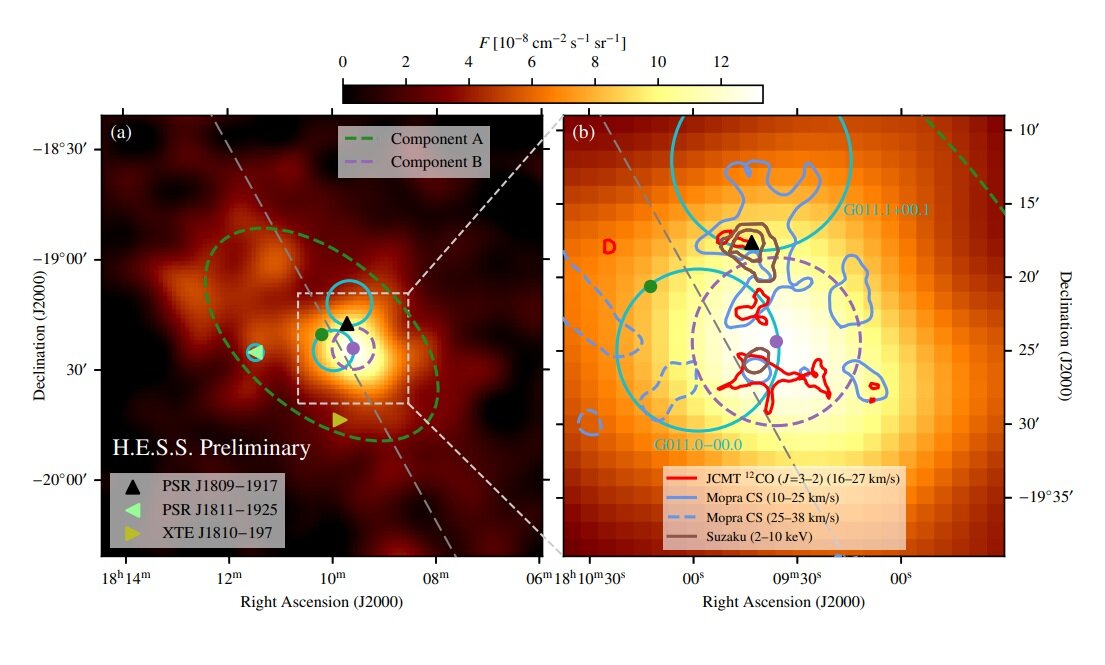
Utilizing the Excessive Power Stereoscopic System (HESS), German astronomers have investigated a very-high-energy (VHE) gamma-ray supply referred to as HESS J1809−193. Outcomes of the research, printed January 18 on the arXiv preprint server, ship vital insights into the properties of gamma-ray emission from this supply.
Sources emitting gamma radiation with photon energies between 100 GeV and 100 TeV are known as very-high vitality (VHE) gamma-ray sources, whereas these with photon energies above 0.1 PeV are referred to as ultra-high vitality (UHE) gamma-ray sources. The character of those sources remains to be not effectively understood; due to this fact, astronomers are consistently looking for new objects of this kind to characterize them, which might shed extra mild on their properties typically.
Found in 2007 as a part of the H.E.S.S. Galactic Airplane Survey (HGPS), HESS J1809−193 is an unassociated VHE (over 100 GeV) gamma-ray supply. Earlier observations of HESS J1809−193 have discovered that the supply is situated in a wealthy surroundings, with an brisk pulsar (designated PSR J1809−1917) at a distance of some 10,750 light years, X-ray pulsar wind nebula (PWN), a number of supernova remnants (SNRs), and molecular clouds.
Lately, gamma-ray emission as much as energies of about 100 TeV has been detected from HESS J1809−193 with the Excessive Altitude Water Cherenkov (HAWC) observatory. The discovering implies that this supply could also be able to accelerating cosmic rays as much as PeV energies.
With a view to confirm this assumption, a staff of astronomers led by Lars Mohrmann of the Max Planck Institute for Nuclear Physics in Heidelberg, Germany, has carried out follow-up observations of HESS J1809−193 utilizing the HESS array of Cherenkov telescopes. Their research was complemented by information from NASA’s Fermi spacecraft.
“We current a brand new evaluation of the TeV gamma-ray emission of HESS J1809−193 with H.E.S.S., primarily based on improved evaluation strategies…. We used 93.2 h of knowledge taken on HESS J1809−193 with the 4 12 m diameter telescopes. For the high-level evaluation, now we have employed the Gammapy bundle and carried out a spectro-morphological probability evaluation that makes use of as enter a background mannequin constructed from archival H.E.S.S. observations,” the researchers defined.
The staff managed to resolve the emission from HESS J1809−193 into two elements (A and B) that exhibit distinct spectra and morphologies. The spectral indices of elements A and B have been measured to be at a stage of two.24 and 1.98, respectively. Nevertheless, the astronomers famous that the higher limits at excessive energies for part A point out that the spectrum might lower off earlier than reaching 100 TeV.
In accordance with the authors of the paper, the outcomes recommend that the prolonged part A of HESS J1809−193 is suitable with a halo of outdated electrons surrounding a compact PWN. On the subject of the part B, they suppose that it might plausibly be of both leptonic or hadronic origin.
The researchers added that the presence of supernova remnants and molecular clouds within the HESS J1809−193 area signifies {that a} hadronic state of affairs must be thought-about, through which a part of the emission could also be as a consequence of cosmic-ray nuclei accelerated by the SNRs and interacting with fuel within the clouds.
Extra info:
Lars Mohrmann et al, Revisiting HESS J1809–193—a very-high-energy gamma-ray supply in an enchanting surroundings, arXiv (2023). DOI: 10.48550/arxiv.2301.07366
Journal info:
arXiv
© 2023 Science X Community
Quotation:
Examine inspects gamma-ray emission from HESS J1809−193 (2023, January 30)
retrieved 30 January 2023
from https://phys.org/information/2023-01-gamma-ray-emission-hess-j1809193.html
This doc is topic to copyright. Other than any truthful dealing for the aim of personal research or analysis, no
half could also be reproduced with out the written permission. The content material is supplied for info functions solely.