


Lively volcanic exercise helped create the moon’s floor minerology as just lately as 2 billion years in the past, leaving an iron-rich and high-calcium floor of basalts geographically youthful than the lunar geology neighborhood beforehand thought, in line with a research that analyzed soil samples introduced again as a part of the Chang’E-5 (CE-5) mission in 2020.
A workforce of researchers led by Prof. Li Chunlai from the Nationwide Astronomical Observatories of the Chinese language Academy of Sciences (NAOC) revealed their findings on Oct. 10 in Nature Communications. The research employed each spectroscopic and X-ray diffraction (XRD) evaluation methods to deduce the mineral composition of lunar soil samples introduced again by CE-5.
“Close to-side lunar soil samples we analyzed turned out to be primarily pyroxene,” mentioned Prof. Li. “This got here as a shock to us, as a result of earlier distant sensing-based research indicated a excessive abundance of olivine—one other frequent volcanic mineral composite within the basalt class.”
Research primarily based on Apollo and Luna-era missions recommended lunar mare (a time period for the darkish basaltic plains fashioned by volcanic activity triggered by historic giant asteroid impacts on the far side of the moon) was formed by lively volcanism between 4.3 billion and three.1 billion years in the past, with most of that exercise between 3.6 billion and three.8 billion years in the past. These older research had been primarily based on information collected from Earth-based telescopes in addition to moon orbiters, corresponding to NASA’s Moon Minerology Mapper.
“Although we are able to infer quite a bit about mineral composition of the moon remotely, having precise lunar soil samples right here on Earth in our lab for analyses opened up the potential for a way more thorough and exact compositional evaluation,” Li mentioned.
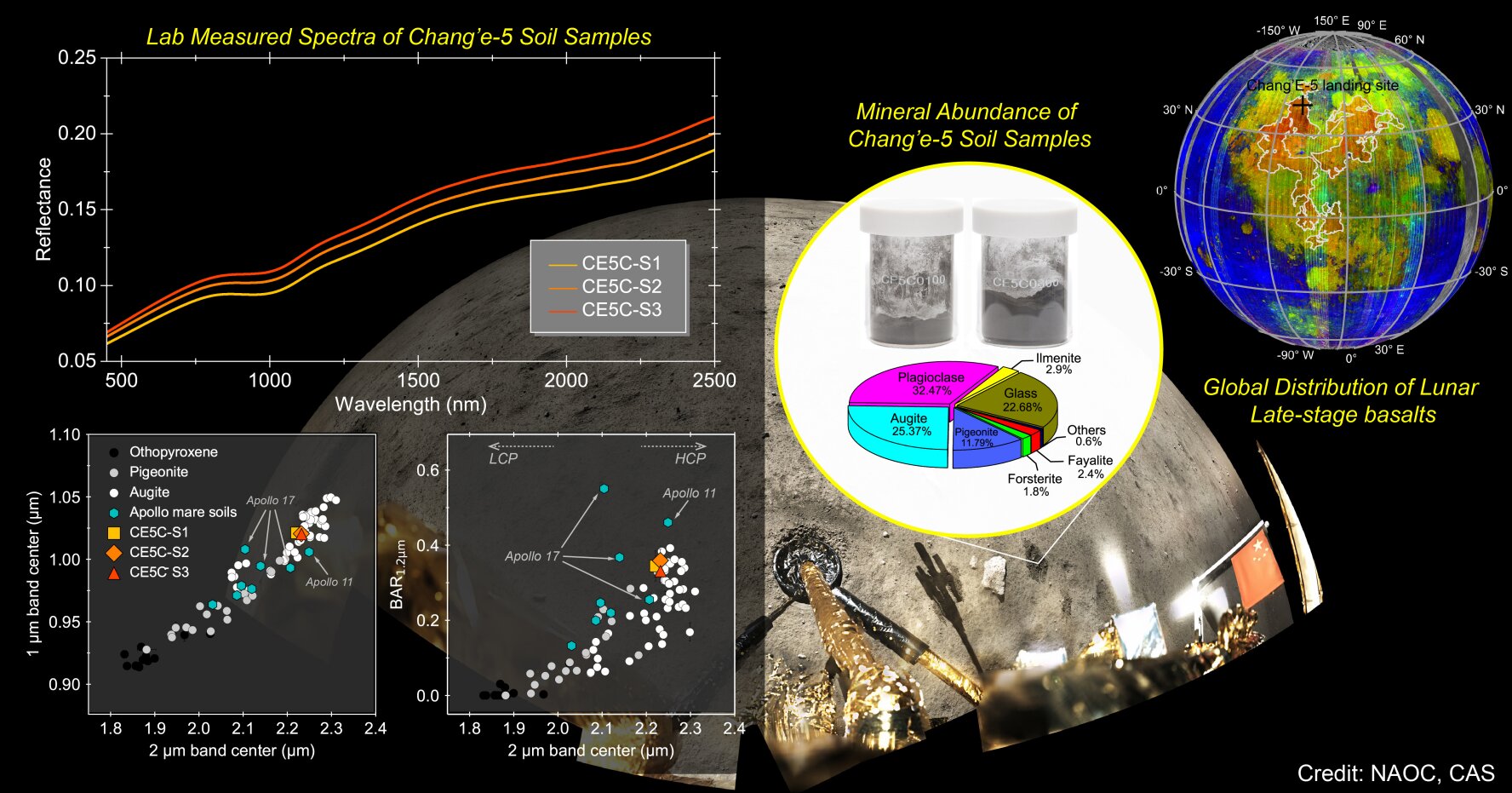
Li and his workforce first analyzed their three soil samples utilizing spectroscopic methods. “The general spectral form of the samples was primarily constant,” Li mentioned. They went on to deploy XRD, which demonstrated the samples had been composed of the minerals augite, pigeonite, plagioclase, forsterite, fayalite, ilmenite, quartz, apatite, and glassy supplies. The XRD consequence confirmed that the samples had been composed of largely pyroxene, not olivine, as earlier research indicated.
“Preliminary works have recognized that the CE-5 returned soil pattern is principally comprised of a kind of lunar basalt which have by no means been sampled earlier than,” Li and his workforce wrote of their Oct. 10 paper. “Compared with the mare samples collected from earlier missions, the majority composition of pyroxene in CE-5 samples is comparatively iron and calcium-rich primarily based on electron microprobe evaluation.”
To investigate the samples, the researchers measure the wavelengths of sunshine absorbed and mirrored when uncovered to exactly calibrated X-ray and visual gentle emissions. What every pattern displays is mapped in line with wavelength on an X-axis and depth on a Y-axis, producing a spectrographic fingerprint.
“There was such a placing similarity among the many three samples,” Li mentioned, “and that means to us that the iron-rich pyroxene we noticed is analogous throughout different near-side mare. This tremendously enhances our understanding of the minerology of the close to aspect of our moon.”
Li and his workforce’s research follows different latest developments which have intrigued lunar scientists in addition to the astronomy neighborhood as a complete, together with information earlier this 12 months additionally generated by CE-5 returned samples signaling that there could also be water on the moon within the type of subterranean trapped ice.
“These are thrilling new developments for lunar geologists,” Li mentioned. “Extra samples introduced again as a part of future missions will proceed to additional our understanding of the moon’s floor and have doubtlessly huge implications for space exploration, because the scientific neighborhood finds methods to make the most of the moon’s minerology, and presumably water.”
Dawei Liu et al, Spectral interpretation of late-stage mare basalt mineralogy unveiled by Chang’E-5 samples, Nature Communications (2022). DOI: 10.1038/s41467-022-33670-6
Quotation:
Returned samples from Chang’E-5 mission shed new gentle on moon’s floor make-up and geologic historical past (2022, October 20)
retrieved 21 October 2022
from https://phys.org/information/2022-10-samples-change-mission-moon-surface.html
This doc is topic to copyright. Other than any honest dealing for the aim of personal research or analysis, no
half could also be reproduced with out the written permission. The content material is supplied for info functions solely.