


A world analysis group led by the College of Minnesota Twin Cities has measured the scale of a star courting again 2 billion years after the Large Bang, or greater than 11 billion years in the past. Detailed pictures present the exploding star cooling and will assist scientists study extra in regards to the stars and galaxies current within the early universe. The paper is printed in Nature.
“That is the primary detailed take a look at a supernova at a a lot earlier epoch of the universe’s evolution,” stated Patrick Kelly, a lead creator of the paper and an affiliate professor within the College of Minnesota College of Physics and Astronomy. “It’s totally thrilling as a result of we are able to study intimately about a person star when the universe was lower than a fifth of its present age, and start to grasp if the celebs that existed many billions of years in the past are completely different from those close by.”
The pink supergiant in query was about 500 instances bigger than the sun, and it is positioned at redshift three, which is about 60 instances farther away than every other supernova noticed on this element.
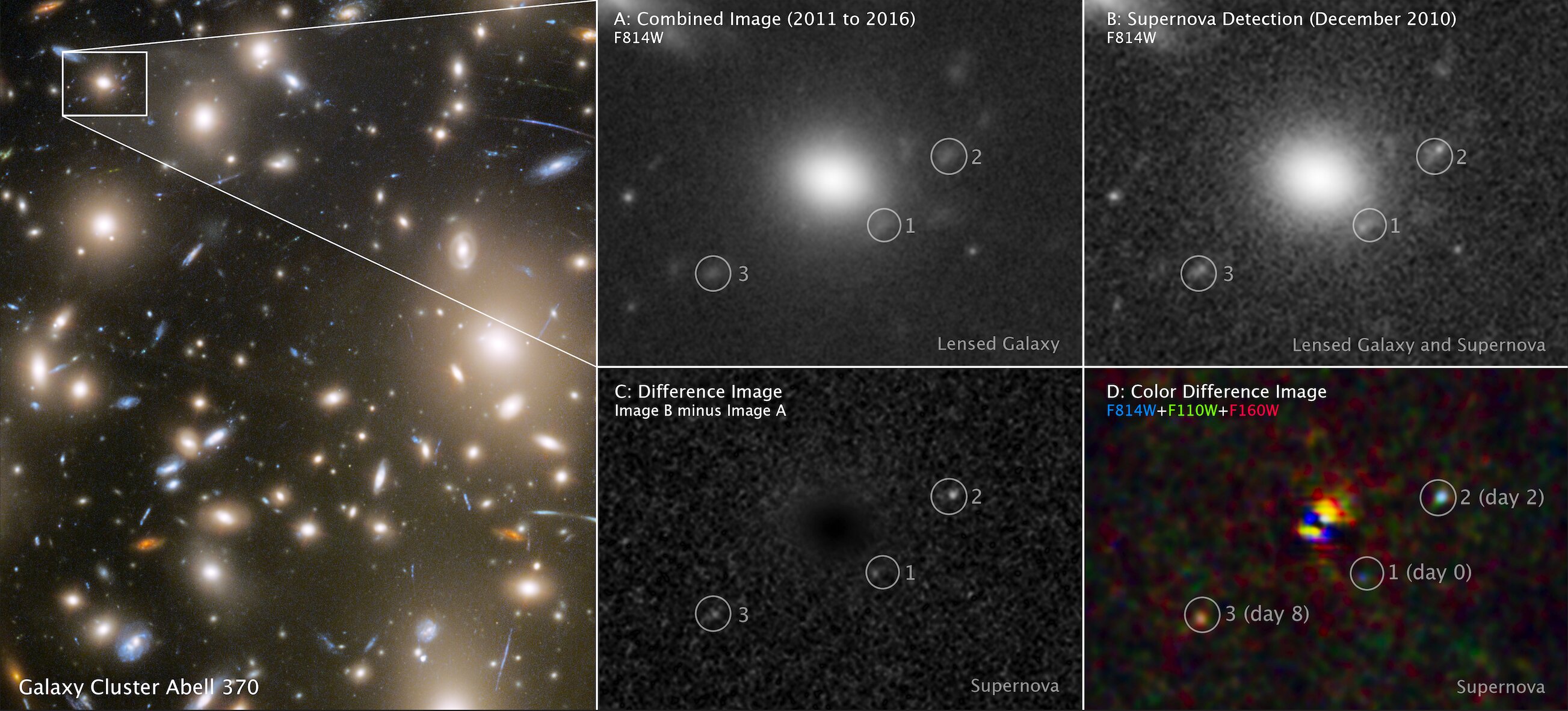
Utilizing information from the Hubble Area Telescope with follow-up spectroscopy utilizing the College of Minnesota’s entry to the Massive Binocular Telescope, the researchers had been in a position to establish a number of detailed pictures of the red supergiant due to a phenomenon referred to as gravitational lensing, the place mass, akin to that in a galaxy, bends mild. This magnifies the sunshine emitted from the star.
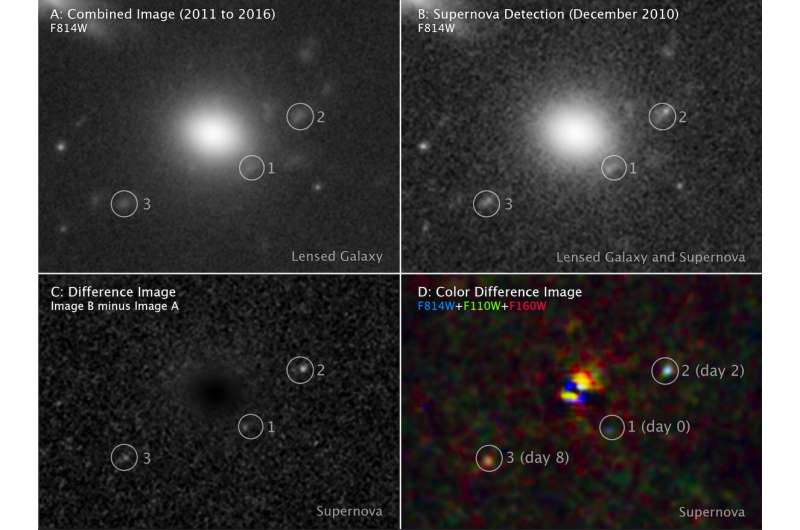
“The gravitational lens acts as a pure magnifying glass and multiplies Hubble’s energy by an element of eight,” Kelly stated. “Right here, we see three pictures. Regardless that they are often seen on the identical time, they present the supernova because it was at completely different ages separated by a number of days. We see the supernova quickly cooling, which permits us to principally reconstruct what occurred and research how the supernova cooled in its first few days with only one set of pictures. It permits us to see a rerun of a supernova.”
The researchers mixed this discovery with one other one in every of Kelly’s supernova discoveries from 2014 to estimate what number of stars had been exploding when the universe was a small fraction of its present age. They discovered that there have been seemingly many extra supernovae than beforehand thought.
“Core-collapse supernovae mark the deaths of huge, short-lived stars. The variety of core-collapse supernovae we detect can be utilized to grasp what number of huge stars had been fashioned in galaxies when the universe was a lot youthful,” stated Wenlei Chen, first creator of the paper and a postdoctoral researcher within the College of Minnesota College of Physics and Astronomy.
Extra info:
Wenlei Chen, Shock cooling of a red-supergiant supernova at redshift 3 in lensed pictures, Nature (2022). DOI: 10.1038/s41586-022-05252-5
Offered by
University of Minnesota
Quotation:
Pink-supergiant supernova pictures reveal secrets and techniques of an earlier universe (2022, November 9)
retrieved 9 November 2022
from https://phys.org/information/2022-11-red-supergiant-supernova-images-reveal-secrets.html
This doc is topic to copyright. Other than any honest dealing for the aim of personal research or analysis, no
half could also be reproduced with out the written permission. The content material is supplied for info functions solely.