


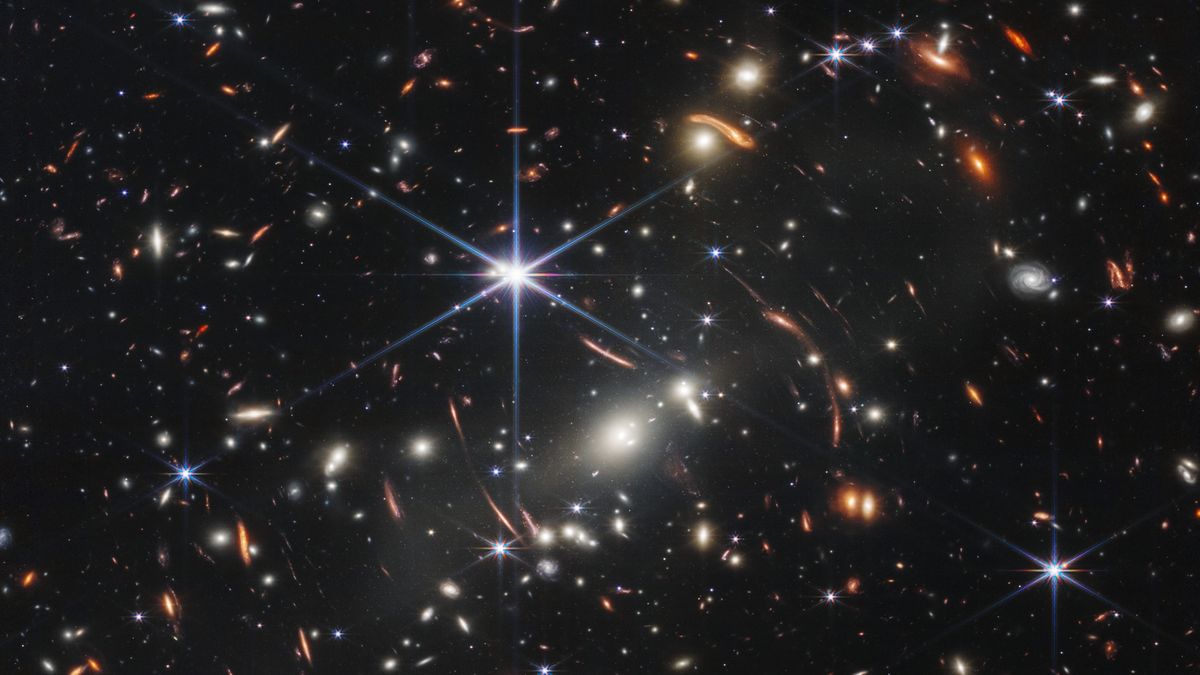
The James Webb Area Telescope, not even completed with its first full yr of observations, has delivered some actual stunners. However amid the breathtaking images and unprecedented findings, there was a puzzling declare: that the telescope had detected galaxies within the extremely younger universe. These galaxies have been so huge and appeared so early that they, the headlines claimed, “broke” the Big Bang mannequin of cosmology.
The declare went viral, however as with many issues on the web, it is merely not true.
Now, there’s extra analysis to again up the Massive Bang. Lately, researchers took a extra cautious have a look at the info and decided that the distant galaxies found by the James Webb Space Telescope are, certainly, completely appropriate with our trendy understanding of cosmology.
Associated: The James Webb Space Telescope never disproved the Big Bang. Here’s how that falsehood spread.
The potential downside with distant galaxies is not that they exist. In reality, the fashionable formulation of the Massive Bang concept, known as ΛCDM cosmology (the Λ stands for darkish vitality, and CDM is brief for “chilly dark matter”), predicts galaxies to look within the very younger universe. That is as a result of billions of years in the past, there have been no galaxies, and even stars, in any respect. When our universe was a lot smaller and far denser than it’s at present, every part was way more uniform, with solely tiny density variations showing right here and there randomly.
However over time, these density variations grew, with the marginally denser pockets pulling extra materials onto them. Over a whole lot of tens of millions of years, these pockets fashioned into the primary stars, and finally grew to change into the first galaxies.
In reality, one of many important targets of the Webb telescope was to discover and characterize those first galaxies, so discovering galaxies within the extremely younger universe is a degree in favor of the Massive Bang concept, not in opposition to it.
So what is the battle, then? The obvious rigidity happened due to the estimated lots of these galaxies. A number of have been fairly giant — properly over 10^10 solar masses. That’s nonetheless a lot smaller than the Milky Way, however for the early universe, they’re fairly gigantic.
The researchers who found these galaxies estimated that their giant lots put them in rigidity with many fashions of galactic formation and evolution. On the excessive finish, the researchers claimed that it would even be doable for no galaxy formation mannequin throughout the ΛCDM framework to create such giant galaxies so rapidly.
A matter of some debate
However these claims hinged on measuring a exact distance to these galaxies — an extremely tough process at these excessive distances. For the record-breaking galaxies that could possibly be rigidity with cosmological fashions, the researchers relied on one thing known as a photometric redshift, which inserts a tough mild spectrum of a galaxy to a mannequin to estimate a distance.
That methodology is notoriously unreliable, with easy results — like extra dust surrounding the galaxies — making them seem extra distant than they are surely.
To precisely choose if the Massive Bang is in bother, a brand new workforce of researchers used Webb to establish galaxies with a way more exact and dependable methodology of figuring out distance, referred to as spectroscopic redshift. This system identifies the spectral traces of recognized components emitted by the galaxies and makes use of them to measure the redshift, and thereby the gap, to the galaxies.
Utilizing this extra correct approach, the workforce discovered a pattern of 4 galaxies. All these galaxies have been simply as distant because the beforehand recognized galaxies, however that they had confirmed, dependable distances. Nevertheless, these galaxies had a lot smaller lots: round 10^8 and 10^9 solar lots.
So the query then turned, does ΛCDM enable for these smaller galaxies to exist at such a younger age within the historical past of the universe, or does the strain stay?
In come the simulations
Constructing galaxies isn’t any straightforward process. Whereas pen-and-paper arithmetic can enable cosmologists to chart the general historical past and evolution of the cosmos throughout the ΛCDM mannequin, galaxy formation includes the advanced interaction of many sorts of physics: gravity, star formation and supernova explosions, dust distribution, cosmic rays, magnetic fields and extra.
Accounting for all these interactions requires using supercomputer simulations that take the uncooked, primal state of the universe because it was billions of years in the past and comply with the legal guidelines of physics to construct synthetic galaxies. That is the one strategy to join what we see in the true world (galaxies) with the elemental parameters of the ΛCDM mannequin (like the quantity of regular and dark matter within the cosmos).
The simulations allowed the researchers to mess around with many sorts of fashions. If no fashions may generate galaxies of that mass at that age, then ΛCDM can be in bother.
Fortunately, there have been no such issues. The looks of galaxies with 10^8 solar lots within the early universe was no sweat for ΛCDM, the workforce defined of their analysis paper, which has been submitted to The Astrophysical Journal Letters and is on the market as a preprint by way of arXiv.
As common, this is not the ultimate reply. Astronomers could but affirm the gap to a really giant galaxy within the early universe which will power us to rethink our understanding of galaxy formation, and perhaps even the ΛCDM cosmological mannequin. In science, it is at all times necessary to maintain an open thoughts. However the exaggerated claims produced from the early Webb information aren’t sufficient to fret about but.
Observe us on Twitter @Spacedotcom or Facebook.