


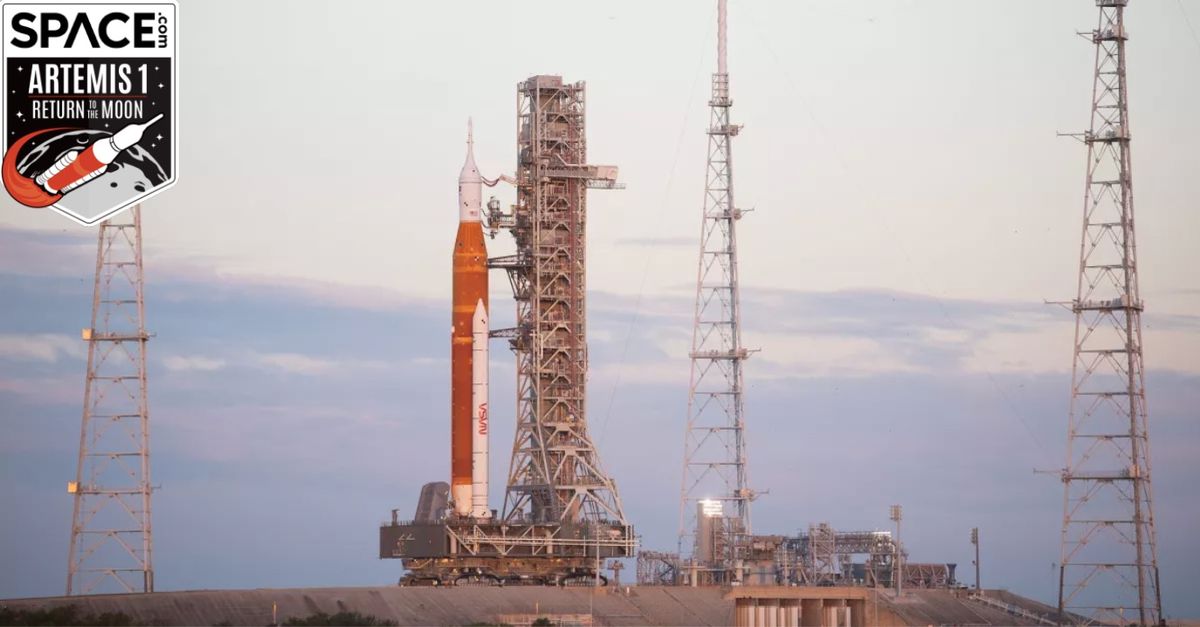
NASA’s Artemis 1 moon rocket survived Tropical Storm Nicole’s wrath in fine condition and stays on observe to launch subsequent Wednesday (Nov. 16) as deliberate, company officers stated.
Nicole slammed into Florida’s House Coast on Thursday (Nov. 10) as a Class 1 hurricane, lashing the area with sturdy winds and driving rain earlier than weakening to a tropical storm. The Artemis 1 stack — a Space Launch System (SLS) megarocket topped by an Orion capsule — took the storm’s punch, enduring it within the open at Pad 39B at NASA’s Kennedy House Heart (KSC).
The SLS and its Orion spacecraft apparently have a robust jaw, for post-storm inspections have revealed solely minor harm that should not forestall an on-time liftoff, NASA officers stated.
“Proper now, there’s nothing stopping us from attending to the sixteenth,” Jim Free, affiliate administrator of the Exploration Programs Improvement Mission Directorate at NASA headquarters in Washington, stated throughout a press convention Friday afternoon (Nov. 11). Liftoff is at present focused for Nov. 16 at 1:04 a.m. EST (0604 GMT).
Associated: NASA’s Artemis 1 moon mission: Live updates
Extra: 10 wild facts about the Artemis 1 moon mission
Nicole pried unfastened some caulking on Orion, despatched some water into the arm that enables entry to the capsule from the Artemis 1 launch tower, and tore one of many SLS engines’ rain covers, Free stated.
The mission group is working its approach by way of these and several other different minor issues and anticipates clearing them in time for a Wednesday liftoff, he added.
This is not to suggest that Artemis 1 is assured to get off the bottom that day, nonetheless; different containers have to be checked as properly.
For instance, the mission group deliberate to energy up each the SLS and Orion on Friday, Free stated, and transfer on to “program-specific engineering exams” on mission {hardware} after that. Any hiccups in these procedures may probably trigger a delay.
Artemis 1 isn’t any stranger to delays. The mission was supposed to launch in late August, however a number of technical glitches pushed the liftoff again a month.
Then, in late September, the group rolled Artemis 1 off Pad 39B and again to KSC’s Car Meeting Constructing (VAB) to shelter from Hurricane Ian, which hit the House Coast onerous.
Mission group members saved SLS and Orion within the VAB for some time, taking the time to carry out some improve and upkeep work. They rolled Artemis 1 back out to the pad on Nov. 4, not lengthy earlier than Nicole boiled up within the Atlantic.
Early forecasts prompt the storm would not current a lot of an issue for SLS and Orion. However Nicole strengthened surprisingly shortly, then set the House Coast in its sights.
On Tuesday (Nov. 8), NASA pushed the deliberate Artemis 1 liftoff again two days, from Nov. 14 to Nov. 16. However by then, it was too late to roll Artemis 1 again to the VAB.
“We weren’t going to have the favorable winds that we would like once we roll,” Free stated.
Staff members did not assume this determination put Artemis 1 in critical jeopardy; the fashions and forecasts prompt that SLS would be capable to deal with the pressure that Nicole pressured upon it. And that turned out to the case, Free stated.
SLS is licensed to resist peak wind gusts of as much as 85 mph (137 kph) on the 60-foot (18 meters) degree “with structural margin,” NASA officials have said (opens in new tab). The utmost wind velocity at that altitude that Nicole threw on the rocket on Thursday was 82 mph (132 kph), Free stated.
Winds had been extra highly effective at greater altitudes on Thursday, however they did not exceed SLS’ design limits, he added.
Artemis 1 is the primary mission in NASA’s Artemis program, which goals to determine a everlasting human presence on and across the moon by the top of the last decade. The flight will ship an uncrewed Orion to lunar orbit and again, on a shakeout cruise designed to reveal that the capsule and SLS are prepared for crewed missions.
The Nov. 16 launch window opens at 1:04 a.m. EDT (0604 GMT) and lasts for 2 hours. If Artemis 1 can not get off the bottom that day, backup alternatives can be found on Nov. 19 and Nov. 25, Free stated.
Mike Wall is the creator of “Out There (opens in new tab)” (Grand Central Publishing, 2018; illustrated by Karl Tate), a guide in regards to the seek for alien life. Comply with him on Twitter @michaeldwall (opens in new tab). Comply with us on Twitter @Spacedotcom (opens in new tab) or on Facebook (opens in new tab).