


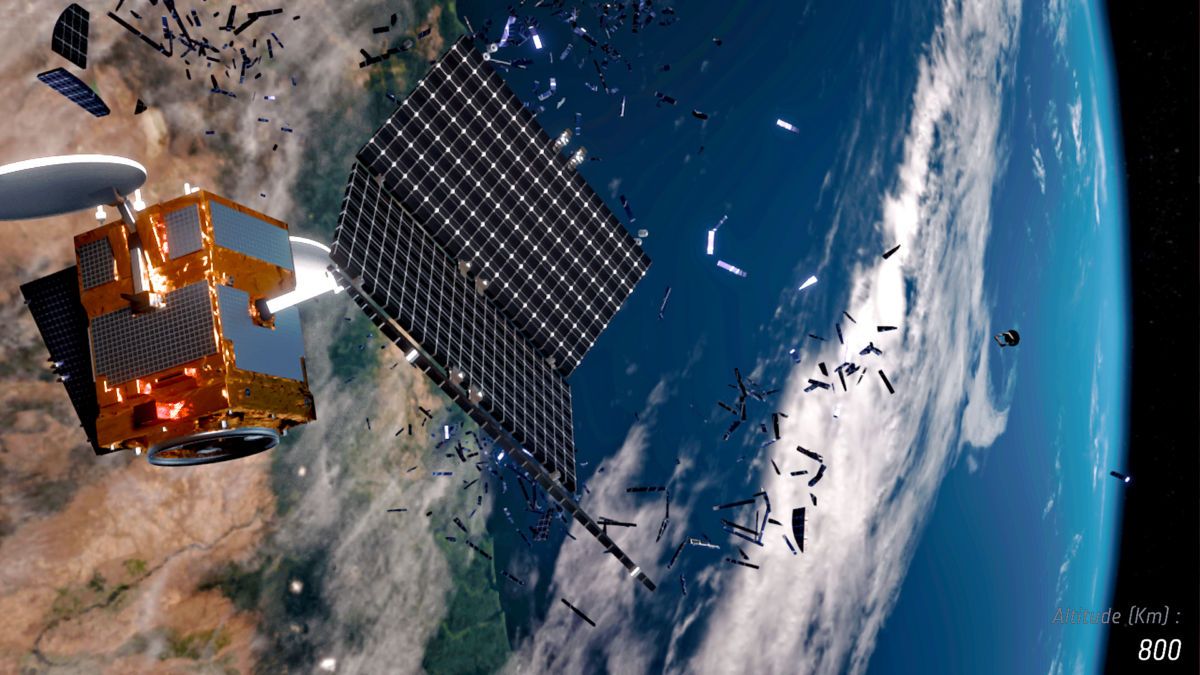
A mysterious Russian satellite broke aside early final month, making a cloud of particles that might linger in Earth orbit for some time.
The Kosmos 2499 spacecraft disintegrated on the evening of Jan. 3, based on the U.S. Space Force‘s 18th Area Protection Squadron (18th SDS), which tracks human-made objects in orbit.
The breakup occasion generated no less than 85 items of trackable particles, 18th SDS said via Twitter on Monday (opens in new tab) (Feb. 6). That cloud of space junk is orbiting 726 miles (1,169 kilometers) above Earth — so excessive that it will seemingly take a century or more (opens in new tab) for ambiance drag to carry it down.
Associated: Getting space junk under control may require an attitude shift
#18SDS has confirmed the breakup of COSMOS 2499 (#39765, 2014-028E) – occurred Jan 4, 2023 at appx 0357 UTC. Monitoring 85 related items at est 1169 km altitude – evaluation ongoing. #spacedebris #space @SpaceTrackOrg @US_SpaceCom @ussfspocFebruary 7, 2023
The 18th SDS didn’t speculate about the reason for the breakup. And that is removed from the one thriller surrounding Kosmos 2499.
The satellite launched to Earth orbit in Could 2014 atop a Russian Rockot car together with three Rodnik navy communications satellites, according to RussianSpaceWeb.com’s Anatoly Zak (opens in new tab).
Kosmos 2499 wasn’t formally on the launch manifest; U.S. satellite trackers initially cataloged it as a bit of particles referred to as Object E, Zak wrote. However then the “particles” started making maneuvers, apparently closing in on the Rockot’s Briz-M higher stage.
“By the top of October [2014], the U.S. formally re-classified Object E as ‘payload’ as an alternative of a ‘fragment’ and at last cataloged it as Kosmos 2499 (with a ‘translated’ spelling ‘COSMOS 2499’),” Zak wrote. “The U.S. navy was now rechecking orbital parameters of the mysterious satellite three or 4 occasions a day!”
Analyses of orbital parts point out that Kosmos 2499 bought inside simply 0.47 miles (0.76 kilometers) of the Briz-M on Nov. 9, 2014, based on Zak. The spacecraft quickly backed off however made a fair nearer method on Nov. 25, coming inside 0.33 miles (0.53 km) of the rocket physique.
Such actions led to hypothesis that Kosmos 2499 and Kosmos 2491, a seemingly related object that launched to Earth orbit in December 2013, have been testing tech that might permit spacecraft to chase down and maybe even disable different satellites. Certainly, Oleg Ostapenko, then the pinnacle of Russia’s federal space company Roscosmos, addressed such rumors at a press convention in December 2014.
“In keeping with Ostapenko, the satellites have been developed in cooperation between Roscosmos and the Russian Academy of Sciences and have been used for peaceable functions, together with unspecified analysis by instructional establishments,” Zak wrote. “‘They accomplished their mission,’ Ostapenko mentioned, with out elaborating what that mission had been.”
Regardless of Ostapenko’s phrases, Kosmos 2499 remained energetic, on and off, for a number of extra years. For instance, the satellite — which floor observations counsel was lower than 1 foot (0.3 meters) large — carried out some maneuvers in early 2017, based on Zak.
However Kosmos 2499’s maneuvering days are actually finished, because the satellite has given up the ghost. And its demise has added but extra particles to an already cluttered surroundings.
According to the European Space Agency (opens in new tab), about 36,500 items of space junk no less than 4 inches (10 centimeters) large zoom round our planet. And people are simply the objects large enough to be tracked; Earth orbit seemingly hosts greater than 130 million objects no less than 1 millimeter throughout.
Even the shards on the low finish of that measurement spectrum can do injury to satellites and different spacecraft, contemplating how briskly orbiting objects transfer. For instance, the International Space Station, which orbits at a mean altitude of roughly 250 miles (400 km), zooms across the planet at about 17,500 mph (28,000 kph).
Mike Wall is the creator of “Out There (opens in new tab)” (Grand Central Publishing, 2018; illustrated by Karl Tate), a guide concerning the seek for alien life. Comply with him on Twitter @michaeldwall (opens in new tab). Comply with us @Spacedotcom (opens in new tab), or on Facebook (opens in new tab) and Instagram (opens in new tab).