


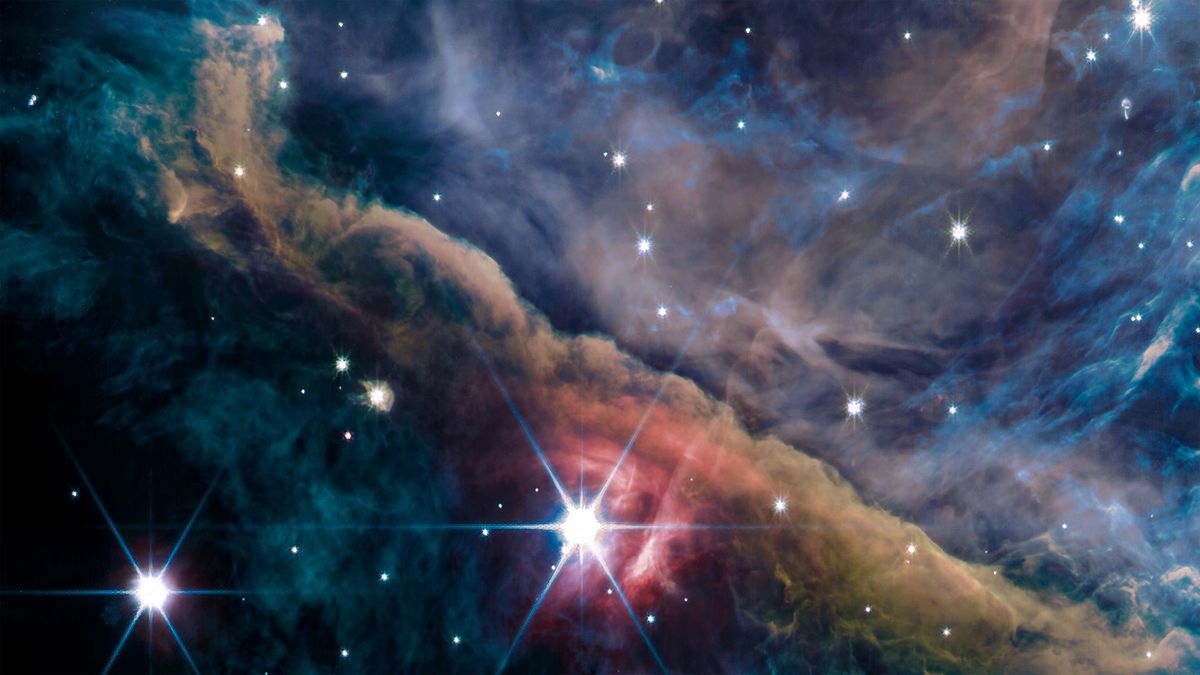
New child stars nonetheless wrapped in cocoons of dust and gasoline are revealed in a brand new picture of the well-known Orion Nebula captured by the James Webb House Telescope.
The picture, taken on Sunday (Sept. 11) with the James Webb Space Telescope‘s NIRCam instrument reveals unprecedented particulars of the Orion Nebula, a identified star-forming area that’s seen even to the bare eye. High quality constructions within the dense dust and gasoline clouds that kind the nebula come to the fore within the picture with a lot higher readability than in a earlier picture captured by Webb’s predecessor, the Hubble Space Telescope.
The nebula, which could be discovered within the night time sky within the constellation Orion simply south of the archer’s belt, includes a wall of dense gasoline and dust often called the Orion Bar. Inside this bar, energetic photons from stars within the Trapezium cluster (within the prime proper nook of the picture) combine with a molecular cloud, triggering complicated ionizing reactions. On the heart of the bar, the star Theta2 Orionis A (or θ2 Ori) shines brightly with the attribute diffraction spikes which might be a side-effect of the design of the James Webb House Telescope’s mirror.
Associated: Marvel at the James Webb Space Telescope’s largest image of the cosmos yet
The picture additionally reveals new-born stars at varied phases of their improvement. Towards the higher left nook of Theta2 Orionis A, contained in the bar, is a younger star forming inside a globule, a shroud of dust and gasoline that has collapsed collectively beneath the pressure of gravity to offer rise to the brand new star. On the right-hand facet, beneath the Trapezium cluster, is a star wrapped in a cocoon of planet-forming materials that’s being eroded by the robust ultraviolet radiation from the Trapezium stars.
Picture 1 of 3

The star on this picture, known as HST-10, is certainly one of about 180 younger stars with “photo-evaporating disks” which were found within the Orion Nebula, scientists stated in a statement.
The picture, a composite created by stacking a number of pictures taken with a number of totally different filters, additionally reveals twisting filaments of hydrocarbon-rich dust and gasoline.
A comparability picture captured with the Spitzer Space Telescope, NASA’s earlier infrared observatory, highlights the technological advances completed via the James Webb House Telescope and the very good stage of element supplied by the brand new telescope.
Observe Tereza Pultarova on Twitter @TerezaPultarova. Observe us on Twitter @Spacedotcom and on Facebook.