


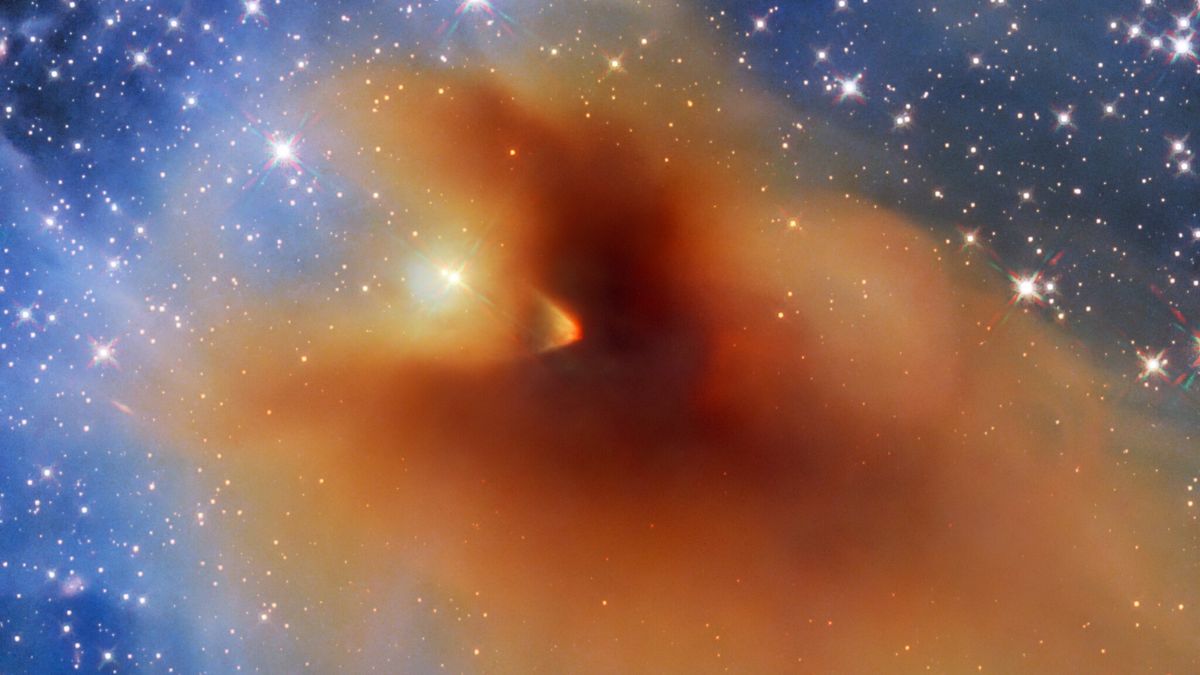
A brand new picture captured by the Hubble House Telescope reveals a molecular cloud of gasoline and dust that harbors a compact object that may quickly change into an toddler star.
Situated 652 light-years from Earth within the constellation of Serpens, CB 130–3 is what astronomers name a dense core, which is a compact agglomeration of gasoline and dust that acts because the constructing blocks for star formation, in keeping with a press release from the European House Company (ESA), a companion on the Hubble Space Telescope mission. Dense cores similar to CB 130–3 are the smallest and densest sorts of molecular clouds. These clouds are stellar nurseries that may be the birthplaces for multitudes of stars, each singularly and in binary pairs.
Many dense cores already include younger stars, whereas others show a gradual inward contraction that precedes the cloud’s full gravitational collapse. Each sorts of dense cores have temperatures of round minus 440 levels Fahrenheit (minus 262 levels Celsius) and are often elliptical.
Associated: The best Hubble Space Telescope images of all time!
In the course of the gravitational collapse of those huge fields of chilly gasoline, sufficient mass can accumulate in choose areas to achieve the excessive temperatures and excessive densities wanted to kick-start the nuclear fusion that marks the delivery of a star and that the star will maintain all through its main-sequence lifetime.
The brand new Hubble picture reveals CB 130–3 resembling maybe a glass of carrot juice spilled throughout a tablecloth of stars and galaxies. The picture provides no trace of the budding star lurking inside the molecular cloud because it teeters on the point of turning into a fully-fledged stellar physique.
Nonetheless, different particulars about CB 130–3 are extra apparent within the picture, which astronomers captured utilizing Hubble’s Wide Field Camera 3. As an example, the picture demonstrates that the density of the molecular cloud is not fixed. The outer edges of CB 130–3 could be seen as tenuous wisps of gasoline that merely blur background stars. In stark distinction, the fabric on the coronary heart of the molecular cloud is so dense that it totally blocks the sunshine from background stars.
The gasoline and dust of CB 130–3 additionally impression the colour of the celebs behind it in addition to their brightness. The celebrities seen by way of the thick materials nearer to the center of CB 130–3 seem to have taken on a redder hue than these shining by way of much less dense materials on the outer edges of the construction.
And this reddening is greater than an fascinating beauty impact. Astronomers can use the change in coloration to map the density of CB 130–3, granting them perception into the construction of this stellar nursery.
Comply with us on Twitter @Spacedotcom or on Facebook.