


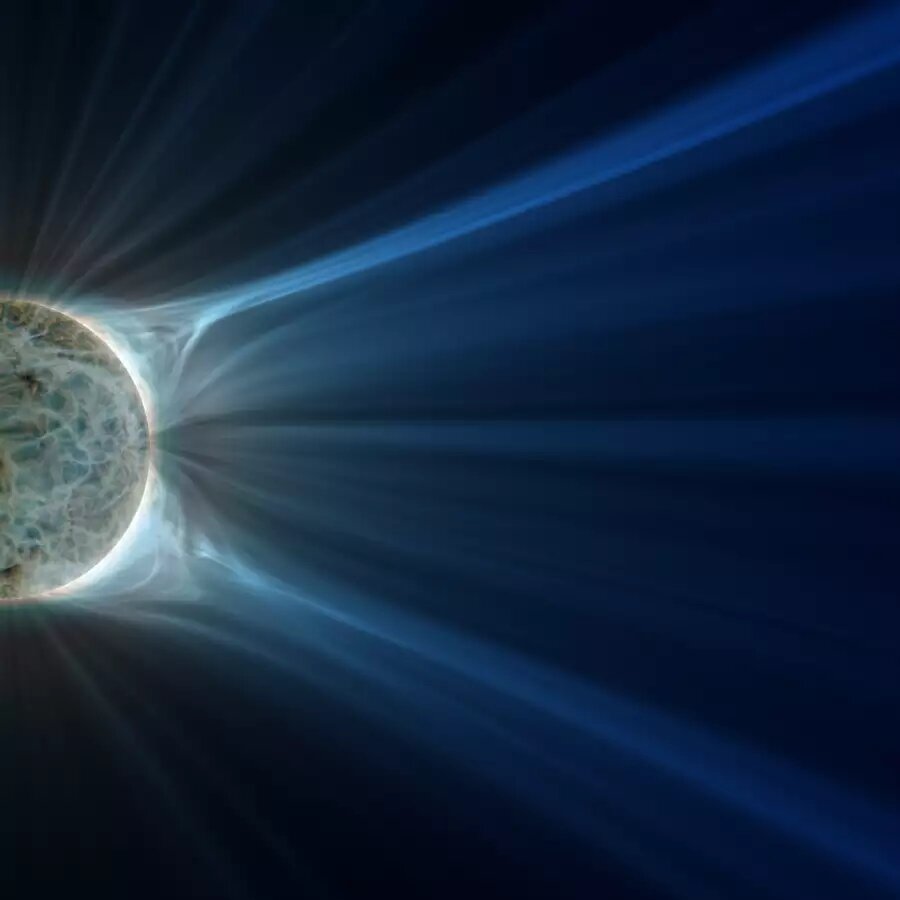
Utilizing observational knowledge from the U.S. climate satellites GOES, a workforce of researchers led by the Max Planck Institute for Photo voltaic System Analysis (MPS) in Germany has taken an vital step towards unlocking one of many sun’s most persevering secrets and techniques: How does our star launch the particles constituting the solar wind into space? The info present a singular view of a key area within the solar corona to which researchers have had little entry thus far.
The workforce has for the primary time captured a dynamic web-like community of elongated, interwoven plasma buildings. Along with knowledge from different space probes and in depth laptop simulations, a transparent image emerges: the place the elongated coronal internet buildings work together, magnetic power is discharged—and particles escape into space.
The Geostationary Operational Environmental Satellites (GOES) of the U.S. Nationwide Oceanic and Atmospheric Administration (NOAA) have historically involved themselves with different issues than the sun. Since 1974, the system has been orbiting our planet at an altitude of about 36,000 kilometers and constantly offering Earth-related knowledge for instance for climate and storm forecasting.
Through the years, the unique configuration has been expanded to incorporate newer satellites. The three most up-to-date ones at the moment working are moreover geared up with devices that have a look at the sun for space climate forecasting. They’ll picture ultraviolet radiation from our star’s corona.
An exploratory observing marketing campaign to picture the prolonged solar corona befell in August and September 2018. For greater than a month, GOES’s Photo voltaic Ultraviolet Imager (SUVI) not solely regarded straight on the sun because it normally does, but additionally captured pictures to both facet of it.
“We had the uncommon alternative to make use of an instrument in an uncommon technique to observe a area that has probably not been explored,” mentioned Dr. Dan Seaton of SwRI, who served as chief scientist for SUVI through the remark marketing campaign. “We did not even know if it will work, however we knew if it did, we might make vital discoveries.”
By combining the pictures from the completely different viewing angles, the instrument’s area of view might be considerably enlarged and thus, for the primary time, the complete center corona, a layer of the solar environment from 350 thousand kilometers above the sun’s seen floor, might be imaged in ultraviolet mild.
Different spacecraft that examine the sun and gather knowledge from the corona, comparable to NASA’s Photo voltaic Dynamics Observatory (SDO) in addition to NASA’s and ESA’s Photo voltaic and Heliospheric Observatory (SOHO), look into deeper or greater layers. “Within the center corona, solar analysis has had one thing of a blind spot. The GOES knowledge now gives a big enchancment,” mentioned Dr. Pradeep Chitta of MPS, lead creator of the brand new examine. Within the center corona, researchers suspect processes that drive and modulate the solar wind.
Touring by means of space at supersonic speeds
The solar wind is considered one of our star’s most wide-reaching options. The stream of charged particles that the sun hurls into space travels all the best way to the sting of our Photo voltaic System, creating the heliosphere, a bubble of rarefied plasma that marks the sun’s sphere of affect. Relying on its pace, solar wind is split into quick and gradual elements.
The so-called quick solar wind, which reaches speeds of greater than 500 kilometers per second, originates from interiors of coronal holes, areas that seem darkish in coronal ultraviolet radiation. The supply areas of gradual solar wind are much less sure although. However even the particles of the gradual solar wind race by means of space at supersonic speeds of 300 to 500 kilometers per second.
This slower part of the solar wind nonetheless raises many questions. Sizzling coronal plasma over a million levels wants to flee the sun to type the gradual solar wind. What mechanism is at work right here? Furthermore, the gradual solar wind will not be homogeneous, however reveals, not less than partly, a ray-like construction of clearly distinguishable streamers. The place and the way do they originate? These are the questions addressed within the new examine.

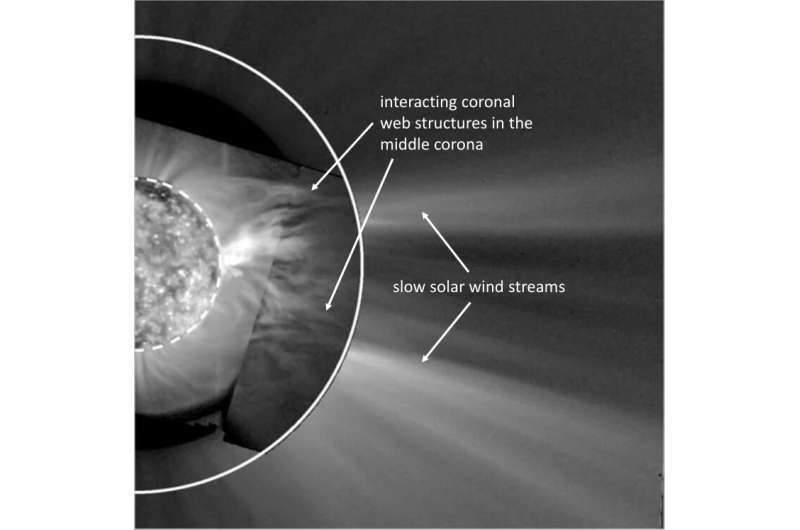
Within the GOES knowledge, a area close to the equator could be seen that aroused the researchers’ specific curiosity: two coronal holes, the place the solar wind streams away from the sun unimpeded, in shut proximity to a area with excessive magnetic area energy. Interactions between programs like these are thought-about to be attainable beginning factors of the gradual solar wind.
Above this area, the GOES knowledge present elongated plasma buildings within the center corona pointing radially outward. The workforce of authors refers to this phenomenon, which has now been straight imaged for the primary time, as a coronal internet. The online is continually in movement: its buildings work together and regroup.
Researchers have lengthy recognized the solar plasma of the outer corona to exhibit the same structure. For many years, the coronagraph LASCO (Giant Angle and Spectrometric Coronagraph) on board the SOHO spacecraft, which celebrated its twenty fifth anniversary final 12 months, has been offering pictures from this area in seen mild. Scientists interpret the jet-like streams within the outer corona because the construction of the gradual solar wind that begins its journey into space there. As the brand new examine now impressively exhibits, this construction already prevails within the center corona.
Affect of the solar magnetic area
To higher perceive the phenomenon, the researchers additionally analyzed knowledge from different space probes: NASA’s Photo voltaic Dynamics Observatory (SDO) offered a simultaneous view of the sun’s floor; the STEREO-A spacecraft, which has been previous Earth on its orbit across the sun since 2006, supplied a perspective from the facet.
Utilizing fashionable computational strategies that incorporate distant sensing observations of the sun, researchers can use supercomputers to construct reasonable 3D fashions of the elusive magnetic area within the solar corona. On this examine, the workforce used a complicated magnetohydrodynamic (MHD) mannequin to simulate the magnetic area and plasma state of the corona for this time interval.
“This helped us join the fascinating dynamics that we noticed within the center corona to the prevailing theories of solar wind formation,” mentioned Dr. Cooper Downs of Predictive Science Inc., who carried out the pc simulations.
Because the calculations present, the buildings of the coronal internet observe the magnetic area traces. “Our evaluation means that the structure of the magnetic area within the center corona is printed on the gradual solar wind and performs an vital function in accelerating the particles into space,” mentioned Chitta. Based on the workforce’s new outcomes, the recent solar plasma within the center corona flows alongside the open magnetic area traces of the coronal internet. The place the sphere traces cross and work together, power is launched.
There may be a lot to counsel that the researchers are on to a elementary phenomenon. “In periods of excessive solar exercise, coronal holes typically happen close to the equator in shut proximity to areas of excessive magnetic area energy,” mentioned Chitta. “The coronal community we noticed is subsequently unlikely to be an remoted case,” he provides.
The workforce hopes to achieve additional and extra detailed insights from future solar missions. A few of them, comparable to ESA’s Proba-3 mission deliberate for 2024, are geared up with devices that particularly goal the center corona. The MPS is concerned in processing and analyzing the info of this mission. Along with observational data from at the moment working probes comparable to NASA’s Parker Photo voltaic Probe and ESA’s Photo voltaic Orbiter, which go away the Earth-sun-line, this may allow a greater understanding of the three-dimensional construction of the coronal internet.
The analysis was revealed in Nature Astronomy.
Extra data:
L. P. Chitta et al, Direct observations of a posh coronal internet driving extremely structured gradual solar wind, Nature Astronomy (2022). DOI: 10.1038/s41550-022-01834-5
Offered by
Max Planck Society
Quotation:
Direct observations of a posh coronal internet uncover an vital clue as to what mechanism drives solar wind (2022, November 25)
retrieved 25 November 2022
from https://phys.org/information/2022-11-complex-coronal-web-uncover-important.html
This doc is topic to copyright. Other than any honest dealing for the aim of personal examine or analysis, no
half could also be reproduced with out the written permission. The content material is offered for data functions solely.