


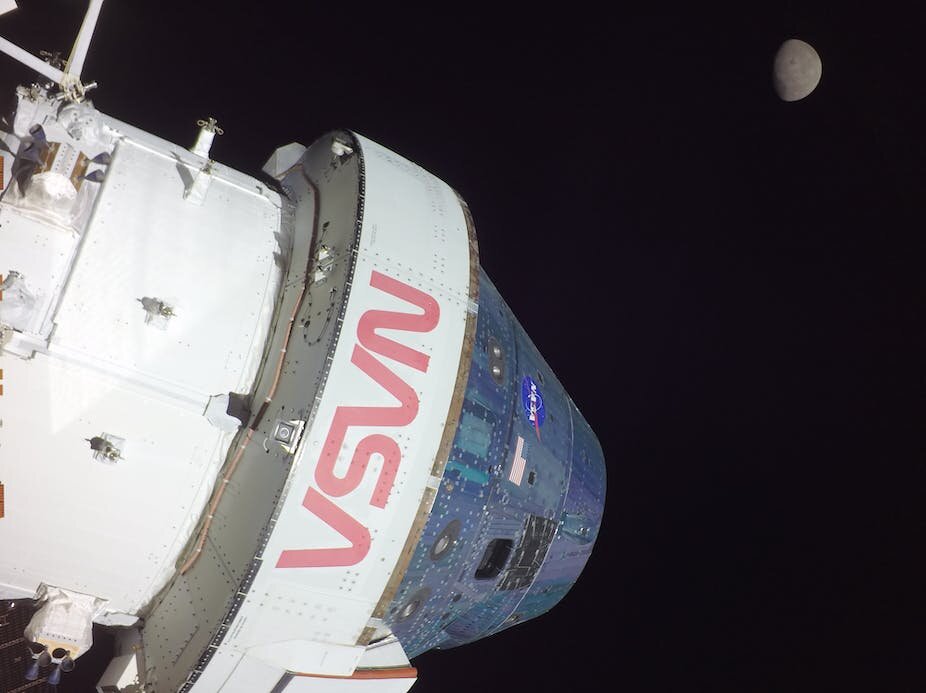
Neil Armstrong took his historic “one small step” on the moon in 1969. And simply three years later, the final Apollo astronauts left our celestial neighbour. Since then, a whole bunch of astronauts have been launched into space however primarily to the Earth-orbiting Worldwide House Station. None has, in truth, ventured quite a lot of hundred kilometres from Earth.
The US-led Artemis programme, nevertheless, goals to return people to the moon this decade—with Artemis 1 on its approach again to Earth as a part of its first take a look at flight, going across the moon.
Essentially the most related variations between the Apollo period and the mid-2020s are a tremendous enchancment in laptop energy and robotics. Furthermore, superpower rivalry can not justify huge expenditure, as within the Chilly Warfare competitors with the Soviet Union. In our current ebook “The End of Astronauts“, Donald Goldsmith and I argue that these modifications weaken the case for the mission.
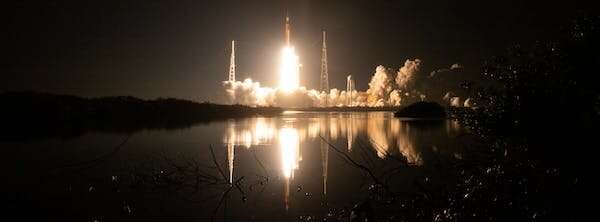
The Artemis mission is utilizing NASA’s model new House Launch System, which is essentially the most highly effective rocket ever—comparable in design to the Saturn V rockets that despatched a dozen Apollo astronauts to the moon. Like its predecessors, the Artemis booster combines liquid hydrogen and oxygen to create huge lifting energy earlier than falling into the ocean, by no means for use once more. Every launch subsequently carries an estimated value of between $2 billion (£1.7 billion) and $4 billion.
That is in contrast to its SpaceX competitor Starship, which permits the corporate to recuperate and the reuse the primary stage.
The advantages of robotics
Advances in robotic exploration are exemplified by the suite of rovers on Mars, the place Perseverance, NASA’s newest prospector, can drive itself via rocky terrain with solely restricted steering from Earth. Enhancements in sensors and artificial intelligence (AI) will additional allow the robots themselves to determine significantly attention-grabbing websites, from which to assemble samples for return to Earth.
Throughout the subsequent one or twenty years, robotic exploration of the Martian floor could possibly be virtually fully autonomous, with human presence providing little benefit. Equally, engineering tasks—akin to astronomers’ dream of developing a big radio telescope on the far aspect of the moon, which is freed from interference from Earth—not require human intervention. Such tasks can be fully constructed by robots.
As a substitute of astronauts, who want a nicely geared up place to reside in the event that they’re required for building functions, robots can stay completely at their work web site. Likewise, if mining of lunar soil or asteroids for uncommon supplies grew to become economically viable, this additionally could possibly be completed extra cheaply and safely with robots.
Robots might additionally discover Jupiter, Saturn and their fascinatingly various moons with little extra expense, since journeys of a number of years current little extra problem to a robotic than the six-month voyage to Mars. A few of these moons might in truth harbour life of their sub-surface oceans.
Even when we might ship people there, it is likely to be a foul thought as they might contaminate these worlds with microbes kind Earth.
Managing dangers
The Apollo astronauts have been heroes. They accepted excessive dangers and pushed expertise to the restrict. As compared, quick journeys to the moon within the 2020s, regardless of the $90-billion value of the Artemis programme, will appear virtually routine.
One thing extra formidable, akin to a Mars touchdown, will likely be required to elicit Apollo-scale public enthusiasm. However such a mission, together with provisions and the rocketry for a return journey, might nicely value NASA a trillion {dollars}—questionable spending after we’re coping with a local weather disaster and poverty on Earth. The steep price ticket is a results of a “security tradition” developed by NASA lately in response to public attitudes.
This displays the trauma and consequent programme delays that adopted the House Shuttle disasters in 1986 and 2003, every of which killed the seven civilians on board. That stated, the shuttle, which had 135 launches altogether, achieved a failure charge beneath two p.c. It will be unrealistic to anticipate a charge as little as this for the failure of a return journey to Mars—the mission would in spite of everything final two entire years.
Astronauts merely additionally want way more “upkeep” than robots—their journeys and floor operations require air, water, meals, residing space and safety towards dangerous radiation, particularly from solar storms.
Already substantial for a visit to the moon, the price variations between human and robotic journeys would develop a lot bigger for any long-term keep. A voyage to Mars, a whole bunch of occasions additional than the moon, wouldn’t solely expose astronauts to far larger dangers, but in addition make emergency help far much less possible. Even astronaut lovers settle for that nearly twenty years might elapse earlier than the primary crewed journey to Mars.
There will definitely be thrill-seekers and adventurers who would willingly settle for far increased dangers—some have even signed up for a proposed one-way journey prior to now.
This alerts a key distinction between the Apollo period and at present: the emergence of a robust, non-public space-technology sector, which now embraces human spaceflight. Personal-sector corporations at the moment are aggressive with NASA, so high-risk, cut-price journeys to Mars, bankrolled by billionaires and personal sponsors, chilly be crewed by keen volunteers. Finally, the general public might cheer these courageous adventurers with out paying for them.
Provided that human spaceflight past low orbit is very more likely to fully switch to privately-funded missions ready to just accept excessive dangers, it’s questionable whether or not NASA’s multi-billion-dollar Artemis mission is an efficient solution to spend the federal government’s cash. Artemis is finally extra more likely to be a swansong than the launch of a brand new Apollo period.
Supplied by
The Conversation
This text is republished from The Conversation below a Inventive Commons license. Learn the original article.
Quotation:
Artemis: why it could be the final mission for NASA astronauts (2022, November 25)
retrieved 25 November 2022
from https://phys.org/information/2022-11-artemis-mission-nasa-astronauts.html
This doc is topic to copyright. Aside from any honest dealing for the aim of personal examine or analysis, no
half could also be reproduced with out the written permission. The content material is offered for info functions solely.