

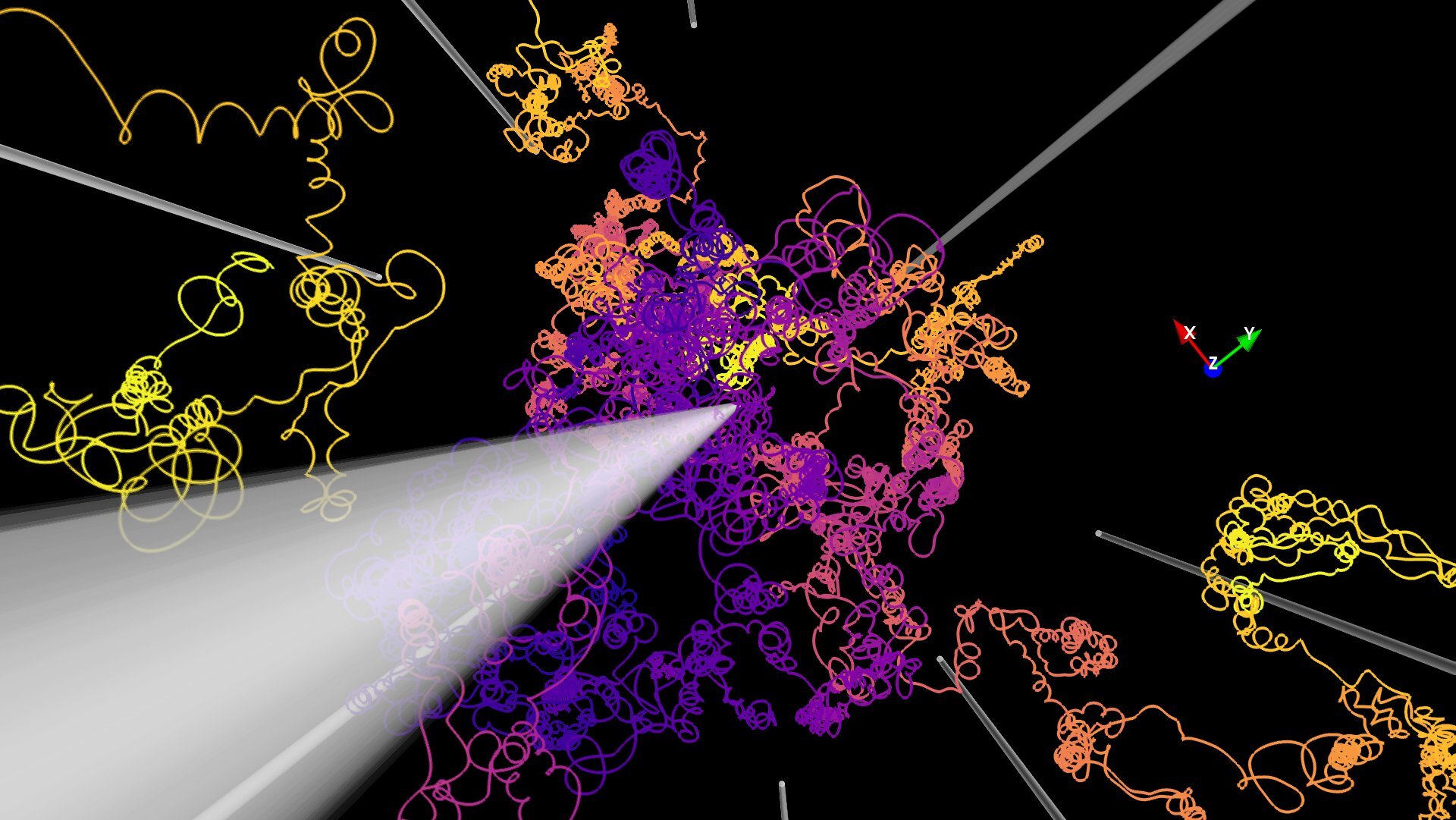
A global analysis crew has developed a pc program that may simulate the transport of cosmic rays by way of space. The researchers hope it should assist them resolve the thriller of the sources of cosmic rays.
Thus far, we have no idea which celestial objects emit the high-energy radiation that pelts the Earth from space. Theoretical fashions are mandatory to elucidate experimental data; the brand new pc simulation can present these. A crew of researchers from Ruhr-Universität Bochum (RUB) describes the software program within the Journal of Cosmology and Astroparticle Physics.
Like an evenly illuminated sky throughout daytime
Since their discovery 100 years in the past, researchers have been trying to decipher the place cosmic rays come from. The issue is that, seen from Earth, they appear like the sky throughout daytime to the bare eye—specifically, equally brightly illuminated virtually in all places we glance.
It is because the sunshine from the sun is scattered within the Earth’s environment and spreads evenly throughout the whole sky. Cosmic rays are additionally scattered on their technique to Earth—by way of interactions with cosmic magnetic fields. All we are able to see from Earth is an evenly illuminated picture; the origin of the radiation stays hidden.
Particle trajectories simulated all the best way from manufacturing to detection
“Our program CRPropa permits us to hint the trajectories of particles from their formation to their arrival on Earth—and this for all energies that we are able to observe from Earth,” says Julien Dörner, Ph.D. pupil at RUB. “We will additionally absolutely account for the interplay of the particles with matter and photon fields within the universe.”
This system can simulate not solely cosmic ray propagation, but additionally signatures of neutrinos and gamma rays which are produced in cosmic ray interactions. “Not like cosmic rays, these messenger particles could be noticed immediately from their sources, as they arrive to Earth on a straight path,” explains Dr. Patrick Reichherzer, postdoctoral researcher at RUB. “We will additionally use the software program to foretell such signatures from neutrinos and gamma rays from distant galaxies resembling starbursts or energetic galaxies.”
The offered simulation program is presently essentially the most complete software program and opens up new home windows to the universe. “We will discover new power ranges within the simulation that could not absolutely be captured in such element with the applications out there to this point,” says Professor Karl-Heinz Kampert from the College of Wuppertal. “Most significantly, we are able to develop a theoretical mannequin that describes the transition from cosmic rays from our personal Galaxy to a fraction coming from distant galaxies and examine it with observations.”
Theoretical calculations important to interpret experimental information
The simulation program was developed on account of a global collaboration of 17 researchers from Germany, Spain, the Netherlands, Italy, Croatia, England and Austria. With eight researchers, the RUB is a lead associate within the mission. The mission was carried out as a part of the Collaborative Analysis Centre (CRC) 1491 The Interaction of Cosmic Matter, funded by the German Analysis Basis.
CRC spokesperson Professor Julia Tjus from the RUB says that “the publication is a significant step in the direction of a quantitative description of the transport and interplay of cosmic rays in three dimensions. CRPropa will considerably contribute to understanding the place cosmic rays come from. In spite of everything, we want theoretical calculations to assist us interpret the number of information we obtain from the varied devices monitoring the cosmos.”
Rafael Alves Batista et al, CRPropa 3.2—a sophisticated framework for high-energy particle propagation in extragalactic and galactic areas, Journal of Cosmology and Astroparticle Physics (2022). DOI: 10.1088/1475-7516/2022/09/035
Quotation:
New pc simulation aids within the seek for the origin of cosmic rays (2022, September 13)
retrieved 13 September 2022
from https://phys.org/information/2022-09-simulation-aids-cosmic-rays.html
This doc is topic to copyright. Other than any honest dealing for the aim of personal examine or analysis, no
half could also be reproduced with out the written permission. The content material is supplied for data functions solely.