


Astronomers have made essentially the most intensive examine but of how magnetically lively stars are when they’re younger. This provides scientists a window into how X-rays from stars just like the sun, however billions of years youthful, might partially or utterly evaporate the atmospheres of planets orbiting them.
Many stars start their lives in “open clusters,” loosely packed teams of stars with up to a couple thousand members, all shaped roughly on the similar time. This makes open clusters priceless for astronomers investigating the evolution of stars and planets, as a result of they permit the examine of many stars of comparable ages solid in the identical surroundings.
A staff of astronomers led by Konstantin Getman of Penn State College studied a pattern of over 6,000 stars in 10 totally different open clusters with ages between 7 million and 25 million years. One of many objectives of this examine was to learn the way the magnetic exercise ranges of stars like our sun change through the first tens of hundreds of thousands of years after they kind. Getman and his colleagues used NASA’s Chandra X-ray Observatory for this examine as a result of stars which have extra exercise linked to magnetic fields are brighter in X-rays.
A paper describing the staff’s outcomes was revealed within the August subject of The Astrophysical Journal and is accessible on-line. Coauthors of the paper are Eric D. Feigelson and Patrick S. Broos from Penn State College, Gordon P. Garmire from the Huntingdon Institute for X-ray Astronomy, Michael A. Kuhn from the College of Hertsfordshire, Thomas Preibisch from Ludwig-Maximilians-Universitat, and Vladimir S. Airapetian from NASA’s Goddard Area Flight Middle.
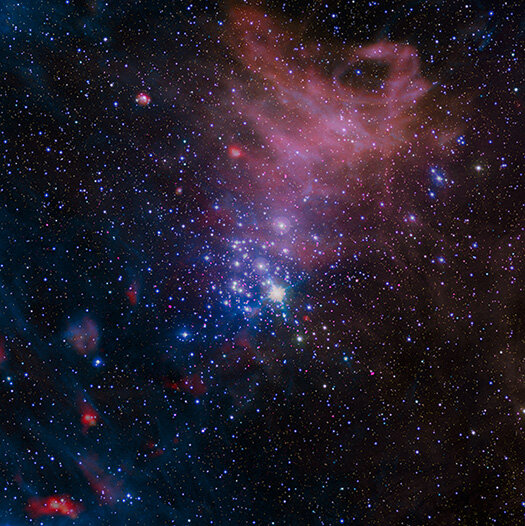
This composite picture exhibits a kind of clusters, NGC 3293, which is 11 million years outdated and is positioned about 8,300 light-years from Earth within the Milky Way galaxy. The picture comprises X-rays from Chandra (purple) in addition to infrared information from ESA’s Herschel Area Observatory (crimson), longer-wavelength infrared information from NASA’s retired Spitzer Area Telescope (blue and white), and optical information from the MPG/ESO 2.2-meter telescope at ESO’s La Silla Observatory in Chile showing as crimson, white and blue.
The researchers mixed the Chandra information of the celebrities’ exercise with information from ESA’s Gaia satellite—not proven within the new composite picture—to find out which stars are within the open clusters and which of them are within the foreground or background. The staff recognized practically a thousand members of the cluster.
They mixed their outcomes for the open clusters with beforehand revealed Chandra research of stars as younger as 500,000 years outdated. The staff discovered that the X-ray brightness of younger, sun-like stars is roughly fixed for the primary few million years, after which fades from 7 to 25 million years of age. This lower occurs extra shortly for heftier stars.
To elucidate this decline in exercise, Getman’s staff used astronomers’ understanding of the inside of the sun and sun-like stars. Magnetic fields in such stars are generated by a dynamo, a course of involving the rotation of the star in addition to convection, the rising and falling of scorching fuel within the star’s inside.
Across the age of NGC 3293, the dynamos of sun-like stars turn into a lot much less environment friendly as a result of their convection zones turn into smaller as they age. For stars with lots smaller than that of the sun, it is a comparatively gradual course of. For extra huge stars, a dynamo dies away as a result of the convection zone of the celebrities disappears.
How lively a star is instantly impacts the formation processes of planets within the disk of fuel and dust that surrounds all nascent stars. Probably the most boisterous, magnetically lively younger stars shortly clear away their disks, halting the expansion of planets.
This exercise, measured in X-rays, additionally impacts the potential habitability of the planets that emerge after the disk has disappeared. If a star is extraordinarily lively, as with many NGC 3293 stars within the Chandra information, then scientists predict it should blast planets in its system with energetic X-rays and ultraviolet gentle. In some circumstances, this high-energy barrage might trigger an Earth-sized rocky planet to lose a lot of its authentic, hydrogen-rich ambiance via evaporation inside a couple of million years. It may also strip away a carbon dioxide-rich ambiance that types later, until it’s protected by a magnetic area. Our planet possesses its personal magnetic area that prevented such an final result for Earth.
Extra data:
Konstantin V. Getman et al, Evolution of X-Ray Exercise in The Astrophysical Journal (2022). DOI: 10.3847/1538-4357/ac7c69
Offered by
Chandra X-ray Center
Quotation:
Astronomers make most intensive examine but of younger stars’ magnetic exercise (2022, December 15)
retrieved 15 December 2022
from https://phys.org/information/2022-12-astronomers-extensive-young-stars-magnetic.html
This doc is topic to copyright. Other than any truthful dealing for the aim of personal examine or analysis, no
half could also be reproduced with out the written permission. The content material is supplied for data functions solely.